
Why Is Flame-Retardant FDM Material Important for Rail System Parts?
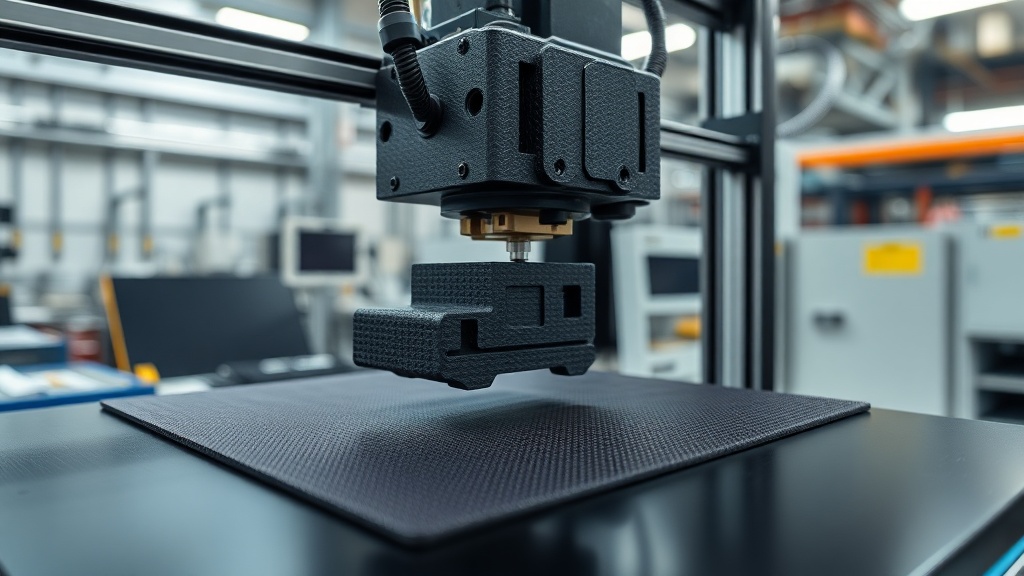
Flame-retardant FDM material matters because, in rail-system applications such as covers, housings, mounting fixtures and spare parts, it bridges the gap between safety standards and manufacturability. The new FDM PA6/66-GF30-FR material Stratasys announced on 17 June 2026 targets exactly this need: safer, certification-ready and faster functional part production.
This development is not some distant story that concerns only large industrial players. In additive manufacturing, new material announcements reveal which part types on the FDM side are getting closer to real-world field use. Especially in transportation, industrial equipment and maintenance-repair processes, the role of 3D printing is no longer limited to visual prototypes; strength, thermal behavior and safety requirements are moving to the center of design decisions.
What does the new material promise?
The FDM PA6/66-GF30-FR announced by Stratasys is positioned as a glass-fiber-reinforced nylon composite with flame-retardant properties. The company states that the material was developed to address fire safety requirements such as EN 45545-2 HL2 and FMVSS 302. In short, the goal is to enable rail-system and transportation manufacturers to carry out safer FDM production for end-use parts or critical spare-part categories.
- Higher rigidity and strength
- Safety-focused use cases thanks to flame-retardant structure
- A functional-part approach with a nylon-based structure
- Faster supply potential for spare parts and low-volume production
The important aspect of this news is that FDM technology is moving a little further away from the “prototype only” perception. Of course, not every material delivers the same result on every printer or in every service model; but the direction of the market shows that high-performance filament-based production is entering more industrial scenarios.
Why does this news matter from Ucuz3D’s perspective?
Because Ucuz3D works exclusively with FDM, developments like this are directly valuable for understanding real-world needs. Especially for jobs such as housings, carrier fixtures, functional prototypes and low-volume spare parts, material selection is no longer just a matter of “PLA or PETG?” For more advanced applications, the approach of printing with engineering materials becomes important.
The critical point here is this: the product mentioned in the news is a specialized FDM material with specific industrial certification goals. So it would be wrong to read it directly as “we produce the exact same thing.” But the news clearly shows that criteria such as flame resistance, structural performance and transportation applications will be discussed more in the FDM world. Likewise, to see why the nylon family is preferred for strength-focused parts, it is worth taking a look at our Nylon (PA) filament guide.
In which part groups can the impact be felt?
This kind of material news draws the most attention in the following use scenarios: quickly replaceable covers for maintenance teams, cable-routing parts, electrical-electronic housings, interior trim components, fastening fixtures and low-volume service parts. Jobs that stall in traditional manufacturing because of tooling costs can be tested more nimbly with FDM. If your design for a similar functional part is ready, you can upload your file and start from the instant price calculation step.
Especially on the transportation and industrial side, what matters is not just printing the part; it is evaluating the part geometry, load direction, temperature conditions and mounting point together. That is why a material announcement alone is not enough; the mechanical and environmental conditions required by the application must also be read correctly from the start.
Conclusion
Stratasys’ new announcement is a strong signal that industrial use is expanding on the flame-retardant FDM material front. This means FDM is being taken seriously in more spare-part, fixture and functional-prototype scenarios. If you are working on a strength-focused part, clarifying your project early for the right material and the right production approach gives you the biggest advantage.
If you want to make a part that looks complex producible with FDM, you can start with your technical file and evaluate the best path together.


 Türkçe
 العربية
 Русский
 فارسی
فارسی Deutsch