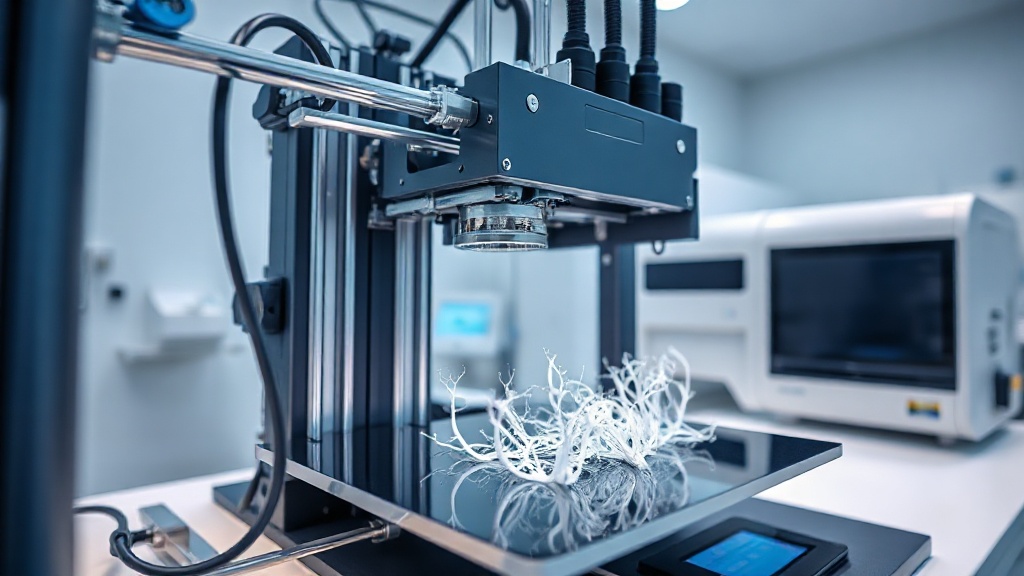

Notre Dame and Harvard Push 3D Bioprinting to Capillary-Scale Vessel Networks
Medical 3D printing has a notable new development: researchers from the University of Notre Dame and Harvard Medical School have announced that they successfully 3D bioprinted vascular networks approaching capillary scale. According to a report by 3D Printing Industry dated June 18, 2026, the team demonstrated a significant milestone in one of tissue engineering’s most critical challenges — producing vessel structures fine enough to keep cells alive. While these studies do not translate directly into clinical products, they clearly indicate where prototyping, testing, and manufacturing infrastructure in medical production is heading.
Why does capillary scale matter?
One of the biggest technical limitations in bioprinting is sustaining oxygen and nutrient transport in structures thicker than a few hundred microns. The research team addressed this challenge more realistically by creating channels that can reach below 10 microns, with some examples approaching the 5–6 micron range. The highlight of the report is not just the production of fine channels, but the ability to controllably print branching, hierarchical networks that more closely resemble natural vascular architecture. This could pave the way for more meaningful tissue testing in laboratory settings in the future.
What does this development mean technically?
The study uses a hybrid approach: different printing methods are combined so that both large vessel-like channels and much finer capillary structures are addressed within the same system. The researchers also improve printing precision through machine-learning-assisted parameter tuning. In the short term, the strongest impact is the potential to create more reliable experimental environments for applications such as drug testing and disease modeling. In the long term, the goal is to approach larger and more functional artificial tissues.
An important distinction must be made clear: this news covers a bioprinting research effort that is separate from the FDM manufacturing services offered by Ucuz3D. That said, for parts such as concept validation, enclosures, fixtures, training models, and functional prototypes used in medical product development processes, medical and dental 3D printing solutions still represent a highly valuable production layer.
Practical takeaways for product development teams in Turkey
News like this should not be read solely as academic achievement. It carries three clear messages for medical startups and R&D teams:
- Geometry control is critical: Microfluidics, channel layout, and internal cavity design are gaining even greater importance.
- Rapid iteration provides an advantage: Even when the final biomaterial is different, early-stage fixtures and body prototypes can be quickly validated with FDM.
- Test infrastructure design is growing: Not just the product itself, but fixtures, carriers, specimen holders, and laboratory auxiliary equipment are also becoming part of additive manufacturing.
If you are working on a medical device development or laboratory-focused project, you need to think carefully about print orientation and its relationship to part strength — not just design-for-manufacture. The guide on how print orientation affects part strength offers an excellent foundation on this topic.
Why should Ucuz3D follow this?
This progress in the medical 3D printing ecosystem is raising expectations for more agile prototyping on the local manufacturing side. While bioprinting for clinical use is a separate field, FDM-based prototypes provide time and cost advantages in the development chain leading up to it. If your project includes a manufacturable part, a protective enclosure, or a test fixture, you can upload your file through Ucuz3D and use the instant price calculator to quickly get your first validation.
In summary, the work by the Notre Dame and Harvard teams represents concrete progress on a difficult problem in the world of medical 3D printing. If you need rapid prototyping in your medical R&D process, feel free to contact us to evaluate the right parts for your project in a short time.



 Türkçe
 العربية
 Русский
 فارسی
فارسی Deutsch