
Why Are E3D Bastion Gears Trending for Carbon Fiber Reinforced Filament Prints?
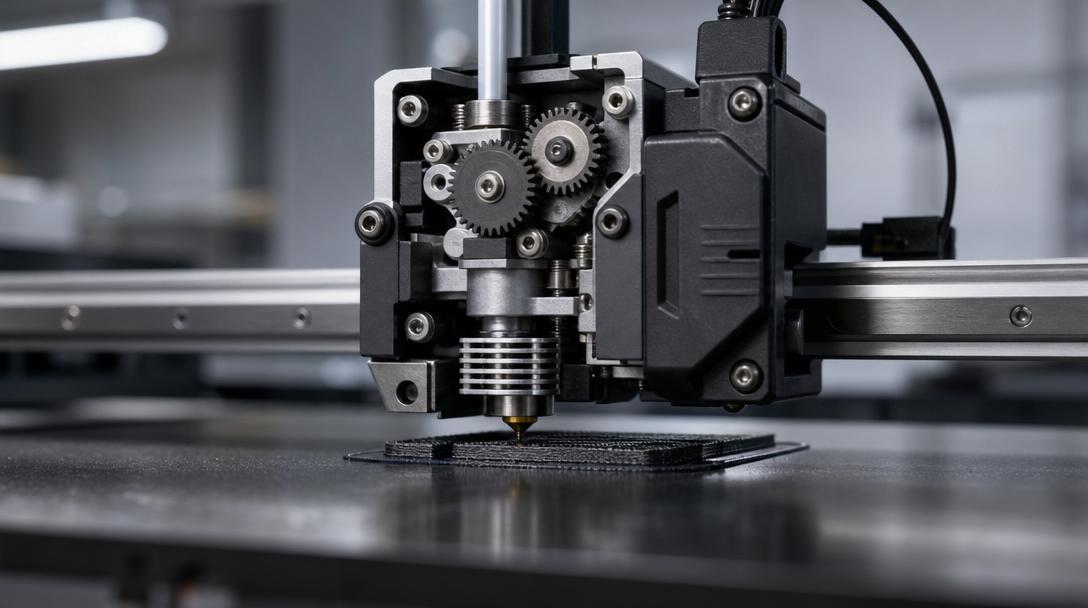
Carbon fiber reinforced filament and similar abrasive materials pose one of the most critical challenges when printing: the wear that builds up on extruder gears over time. The Bastion Coated Gears set that E3D announced on 24 June 2026 targets exactly this problem – keeping filament grip stable for longer on Bambu Lab printers and preserving extrusion consistency across long prints.
According to the details shared on 3D Printing Industry, E3D’s new upgrade consists of hardened steel gear and hobb components compatible with the Bambu Lab X1C, X1E, P1P and P1S models. The real difference, however, lies in the Diamond-Like Carbon (DLC) coating. The company says that friction-related slippage is one of the primary failure modes in extruder gears. This wear can become visible far more quickly, especially with carbon fiber filled, glass fiber filled, glow-in-the-dark and other filled filaments.
Why does this news matter?
In the FDM world, most users talk about nozzle wear; yet the wear on the gears that push the filament also directly affects print quality. According to E3D, extruder gears make roughly 40 rotations for every 1 metre of extruded filament. That translates into thousands of contact cycles over long production runs. The wear may not cause a dramatic failure right away; but over time it can set the stage for issues such as inconsistent extrusion, loss of filament grip and unexpected clogging.
According to the technical data provided in the report, the Bastion coating has a friction coefficient of around 0.1 in dry steel contact. E3D compares this with the roughly 0.6 value of the more general-purpose TiN coating. Furthermore, the fact that the coating thickness is only 0.005 mm shows that the layer is meant to be thin enough not to disturb the part’s tolerance. In the company’s internal tests, the coated gears delivered roughly 5 times better tooth-contact life than uncoated gears running without lubrication; with minimal lubrication, the test was stopped after exceeding 2 million contact cycles.
What does this mean in practice for Ucuz3D?
This development shows that desktop FDM printers are now being prepared not just for PLA prototypes, but for more demanding applications too. As demand grows for printing with engineering materials, especially for jobs that require strength, temperature resistance or more rigid parts, the durability of the printer’s drive components becomes more critical. That is because a loss of stability in technical filaments affects not only quality, but also lead time and the likelihood of a reprint.
The clearest lesson to draw from this is that, in FDM systems running abrasive filaments, the maintenance approach should not be reduced to nozzle replacement alone. The filament feed path, the gear surface and grip performance should also be checked regularly. For that reason, the Extruder Maintenance and Drive Gear Cleaning guide becomes even more meaningful alongside this news, for the teams concerned.
Who should keep an eye on this?
- Teams printing functional parts with carbon fiber or glass fiber filled filaments
- Workshops running long serial prototypes or low-volume production
- Users who want to improve print consistency in a Bambu Lab based workflow
In short, E3D’s Bastion Coated Gears move is one of those “small part, big impact” examples on the desktop FDM side. Although the news is not a brand-new printer launch, it is a fresh reminder of how critical reliable extrusion is for anyone using technical filament. If you too are planning FDM production for functional prototypes, fixtures or spare parts, you can share your project via the request a quote now page and clarify the right production approach.


 Türkçe
 العربية
 Русский
 فارسی
فارسی Deutsch