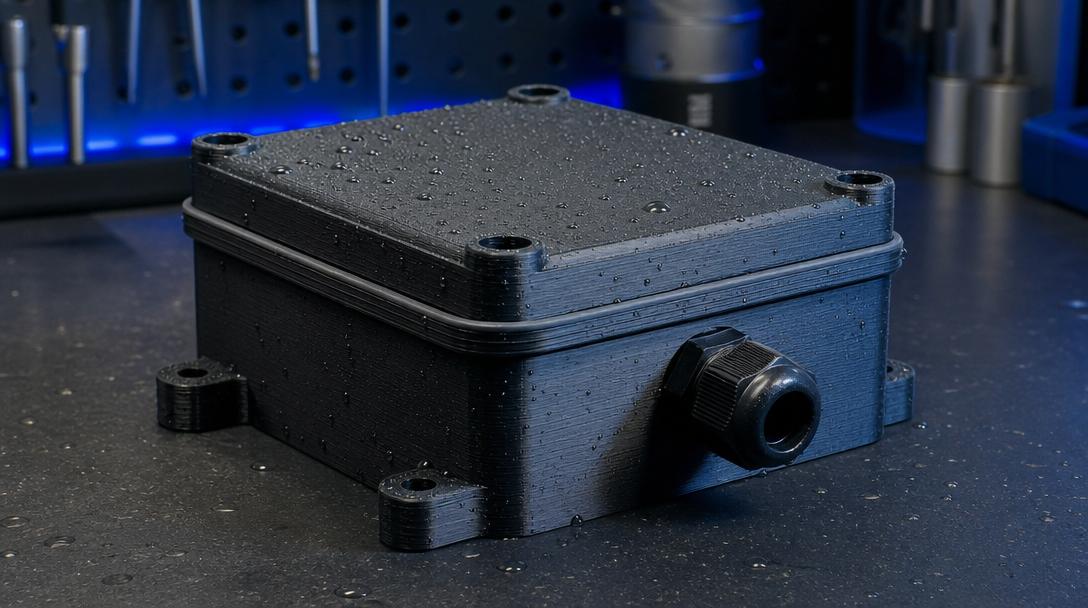

Is 3D Printing Waterproof? Can You Print Watertight Parts?
Is 3D printing waterproof? The short answer is this: standard FDM prints are not completely waterproof, because microscopic gaps can remain between the layers. Even so, with the right material, sufficient wall thickness and the proper print settings, it is entirely possible to produce parts that are quite watertight for everyday use.
Why does water leak through FDM prints?
In FDM technology, a part is built by laying molten filament down layer upon layer. This structure is very practical, but without fine tuning, small gaps can remain at the layer joints, on the top surfaces or in the perimeter walls. This detail becomes especially important for liquid reservoirs, electronics enclosures, irrigation fittings or parts meant for outdoor use.
The main causes of water permeability are:
- Too few walls: Thin perimeter walls can be weak when it comes to watertightness.
- Insufficient top and bottom layers: In closed volumes, micro gaps can form on the top surface.
- Under-extrusion: When the filament does not flow fully, invisible channels appear.
- Wrong part orientation: The layer direction can create a weak axis against pressure and liquid contact.
- Unsuitable material: Not every filament delivers the same outdoor and water-contact performance.
Which material makes more sense for a water-resistant part?
Here the only criterion is not just “waterproofness”; temperature, UV, impact and service life matter too. For general use PETG is often a balanced choice; it behaves more toughly than PLA and gives more reliable results in damp environments. For outdoor parts exposed to sunlight, ASA can stand out. If you need to evaluate more technical and durable options, you can compare the material classes used on our engineering-material printing page.
PLA, while a good material for prototypes and light use, is not ideal in scenarios such as hot water, heat build-up inside a vehicle or long-term outdoor exposure. Especially when gasket-like flexibility is required, a different design approach or a flexible material should be considered; for applications like electronics housings, making the right geometry and material choice with electronics enclosure 3D printing solutions delivers a safer result.
Which settings matter for a more watertight FDM part?
The most critical point in a water-resistant part is not simply increasing the infill ratio, but strengthening the outer shell. In most cases this approach works:
- Increase the number of walls: A range of 3-5 perimeters gives safer results in many jobs.
- Raise the top and bottom layers: Thin cap surfaces are more prone to leaking.
- Choose a balanced layer height: Very coarse settings can reduce surface quality.
- Make sure the flow is correct: Under-extrusion is the main cause of invisible gaps.
- Apply post-processing if needed: Epoxy, a suitable coating or a gasket design can take watertightness further.
At this point, design is at least as important as the print settings. Especially for wall thickness, mating surfaces and how the cap seats, the Wall Thickness and Material Thickness Design Rules guide is very helpful.
When is it actually risky to say “waterproof”?
For parts that operate under pressure, hold liquid continuously or require safety-critical use, the term “fully waterproof” should be used carefully. For example, containers that will stay submerged for a long time, sealing connectors or sensitive electronic enclosures must always be evaluated specifically for the application. In such jobs, design tolerance, cap geometry, gasket groove and material choice should be considered together.
In short, FDM printed parts can let water through; but that does not mean every part is useless. With a properly designed and properly tuned model, you can get very successful results for everyday use. If you want to see the cost of your own part, you can upload your STL file and quickly preview it on the instant price calculator page.




 Türkçe
 العربية
 Русский
 فارسی
فارسی Deutsch