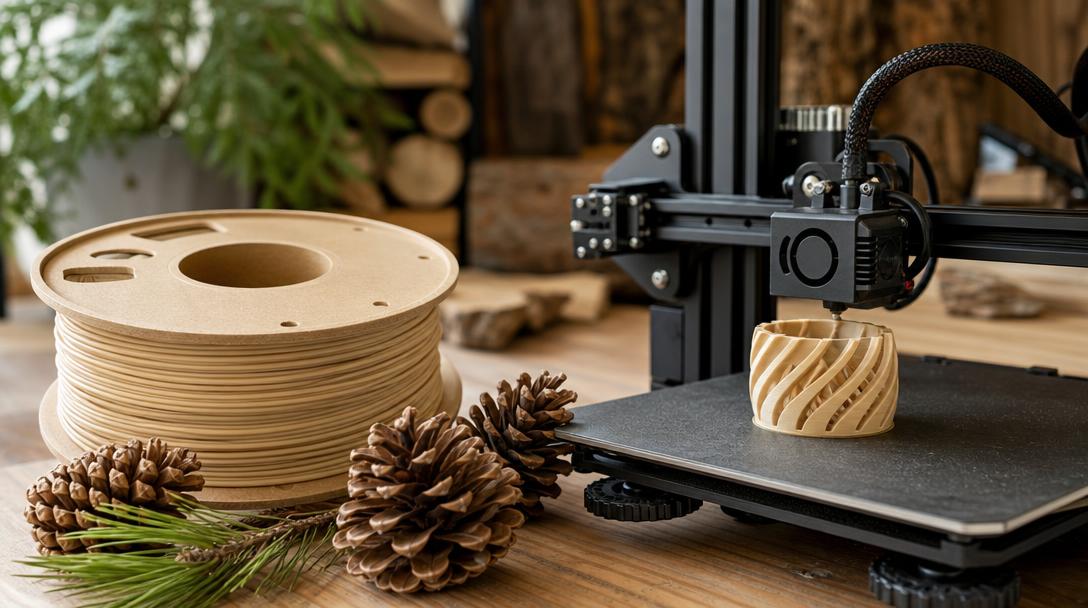

What Does Pine Cone-Filled PLA Filament Promise? A Sustainability Experiment in FDM Materials
When you see a new filament in the workshop, you should look not only at its surface appearance but also at what kind of use the material was developed for. A study by researchers at Ștefan cel Mare University of Suceava in Romania examines whether waste Scots pine cones can be incorporated into PLA for use in desktop FDM printing. The study was published on August 27, 2026 in the journal Sustainability; the related news was reported on September 1, 2026 by Fabbaloo.
In the research, the cones were dried and ground, and particles in the 125–180 micrometer range were selected. Pine cone flour was added to PLA at 5% and 10% by weight. The mixtures were processed through a small single-screw extruder to produce 1.75 mm filament, and test parts were printed using the FFF method on a Creality Ender 3 V2. It was reported that above 10%, the mixture tended to become thicker, clump together, and clog the nozzle.
Why does the 5% blend look more balanced?
Of the two formulations, the filament containing 5% pine cone performed better in mechanical tests. In filament-form samples, the average tensile strength was reported as 21.06 MPa for the 5% blend and 18.51 MPa for the 10% blend. Elongation before breaking was 7.35% and 4.69%, respectively. After printing, the values dropped to around 18 MPa and 14.5 MPa. These results show that the additive does not automatically turn PLA into a stronger engineering material.
The researchers believe that untreated pine cone flour behaves more like a filler than a reinforcement. The biomass absorbing moisture, while PLA is relatively more water-resistant, may create weak zones between the particles and the plastic. This explanation is not presented as a directly measured result in the study, but as a cautious interpretation based on observations. Also, because no additive-free PLA control was tested under the same conditions, the results should not be treated as a definitive head-to-head comparison with standard PLA on the market.
What is it useful for, and what is it not?
The 5% formulation could be interesting for decorative objects, architectural models, lightweight packaging parts, and workshop products that do not carry serious loads. A natural fiber-like additive may add value to designs seeking a different surface texture and appearance. However, this filament should not be seen as a ready engineering alternative for parts operating under high heat, joints exposed to constant impact, precision mechanical elements, or components carrying safety responsibility.
Surface results are mixed as well. Although the 10% additive could provide a smoother appearance on side surfaces, it created more noticeable bulges and irregular voids on top surfaces. The 5% blend, on the other hand, produced cleaner filament and a more consistent print surface. Moisture management may be critical here; the need for dry storage and pre-print drying for a filament containing natural additives should be evaluated together with the manufacturer’s actual printing instructions.
A practical decision for the Ucuz3D reader
This study is an early-stage piece of research showing that the idea of sustainable materials can be adapted to desktop FDM. But a prototype formulation and a commercially stable filament are not the same thing. The diameter tolerance, moisture condition, manufacturer profile, and nozzle compatibility of the material you buy should also be checked. To see the general options, you can look at the our printing materials page.
If you would rather have the part produced with the right material and settings instead of printing it yourself, you can get support from the 3d printing service page. When making your decision, reviewing the logic of the price per gram is healthier than choosing a material based only on spool cost. If your file is ready, you can also consider the production option through the online flow where you can get an instant quote.
In short, pine cone-filled PLA is not, for now, a solution that will replace load-bearing parts; it is a research direction that brings waste biomass into FDM materials and appears more balanced at the 5% level. It is still too early to broaden performance claims without larger sample groups, an additive-free PLA control, and improved particle-plastic bonding.



 Türkçe
 العربية
 Русский
 فارسی
فارسی Deutsch