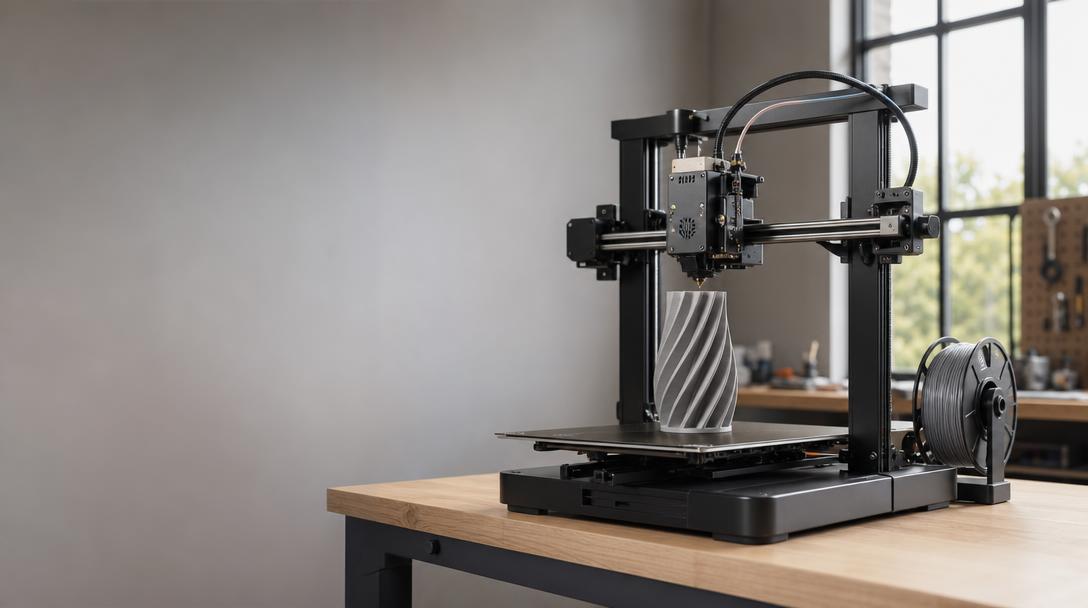

Bambu Lab Patents Target Automatic Head Swapping and Nozzle Monitoring in FDM Printers
Shenzhen Tuozhu Technology, the company behind Bambu Lab, is focusing on two practical issues in FDM printers through three Chinese patent applications dated June 30, 2026: monitoring extrusion during printing and switching between different materials with less waste. According to 3D Printing Industry’s report dated September 2, 2026, the applications do not yet mean a product announcement; however, they show the direction Bambu Lab is exploring for multi-material printing and process control.
What is the focus of the new patents?
The first application describes a printhead design that places lighting elements inside the part-cooling channels. In this setup, the channels that direct airflow also help illuminate the area around the nozzle. The proposed surfaces and light-guiding arrangements are intended to allow the camera to view the extrusion zone in a more controlled way. As a result, the system could gain a camera-based monitoring infrastructure capable of detecting irregular extrusion, material buildup, or other abnormalities that occur during printing and responding through printing parameters.
This approach is not simply about adding a camera. Integrating the lighting into the existing cooling-channel volume is intended to limit the growth of the printhead and reduce overexposure in the image. The application also includes the idea of monitoring opposite areas of the nozzle with two cameras. These are design proposals in the patent; actual print performance and whether they will become a commercial product are still unknown.
Why is a swappable printhead important?
The second and third applications describe a rack system that holds multiple swappable printheads inside the machine. The moving toolhead can pick up the selected printhead from the rack and return it to its place. While each swappable unit contains parts such as the filament path, heater, and nozzle, the main moving system carries part of the extrusion mechanism. The printhead is designed to be selected according to filament type, color, or maintenance needs.
The main promise of this arrangement is reducing the purge requirement caused by a shared hot end in multi-color and multi-material FDM printing. When a separate printhead is used for each material, the same nozzle may not need to purge for long periods during color or material changes. In theory, this could reduce print time, the filament consumed during transitions, and some risks of color mixing. Even so, the real benefit will depend on head-swap speed, printhead calibration, reliable locking of the parts, and the slicing software used.
Positioning and reliability are the critical points of the system
The patents show that the rack is not just a storage area. Guides, pins, hooks, magnets, and spring-loaded locks are proposed to ensure that the printhead approaches in the correct direction and seats in place repeatably after a swap. In some designs, guides at different heights limit lateral movement and rotation. Lowering the print bed during first-layer changes to prevent the nozzle tip from colliding with the bed or the wiping area is also among the details described.
For FDM users, the important lesson here is this: the challenge of multi-material printing is not only how many colors can be connected. Nozzle alignment, safe filament release, the printhead returning to the same position every time, and avoiding damage to the part during swapping are equally important. The patent applications aim to solve these mechanical details; however, durability, maintenance frequency, and total system cost can only be understood through a working product and long-term usage tests.
What it means in practice for Ucuz3D users
If you are producing a single-material or two-material FDM part today, these patents do not mean you need to change your printer immediately. However, reducing purge waste, using different filaments more quickly, and noticing nozzle problems before a print finishes are valuable goals, especially in jobs with high production repeatability. When deciding on a multi-material project, evaluate filament compatibility, drying requirements, and part design together with printhead swapping. To see suitable materials, you can visit our printing materials page.
If you would rather receive production support instead of printing the part yourself, you can review the process on our 3d printing service page. To understand the project’s cost logic, you can check the price per gram information, and to upload your file and evaluate the options, you can move to the online 3d printing tool.
Source and date: 3D Printing Industry, “Bambu Lab patents detail automatic printhead changing and nozzle monitoring systems”, September 2, 2026.



 Türkçe
 العربية
 Русский
 فارسی
فارسی Deutsch