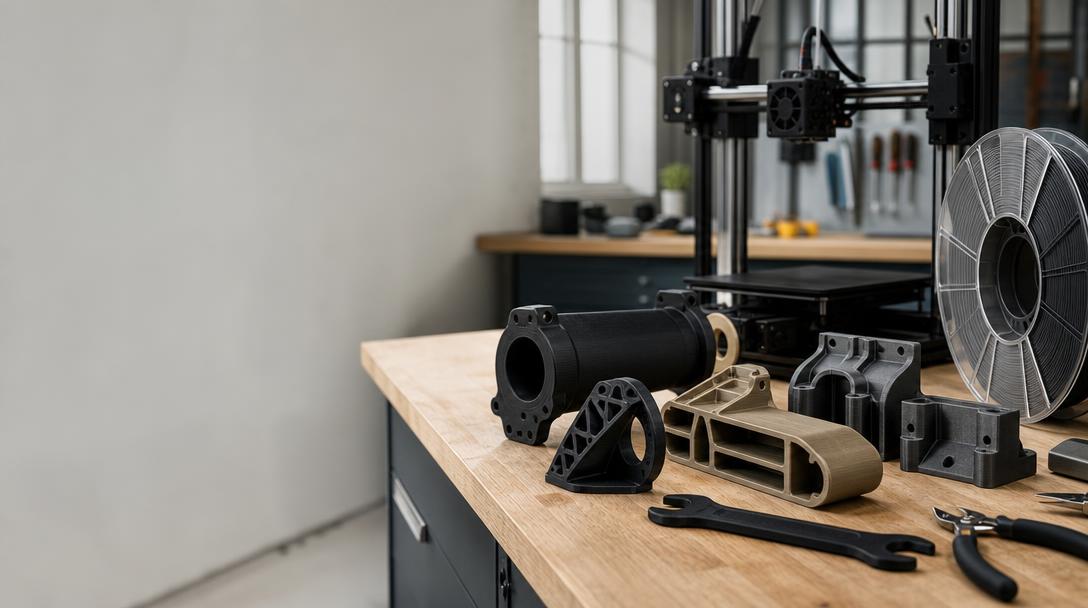

Continuous Composites and the US Navy: A New Stage in 3D Printing for Embedded Electrical Structures
Continuous Composites (CCI) has received a Phase II Small Business Innovation Research (SBIR) contract from the US Navy for a technology that aims to embed electrical transmission into unmanned aerial vehicle (UAV) structures. Announced on 1 September 2026, this development shows how 3D printing is moving beyond simply producing a part’s geometry and toward giving that same structure an electrical function. The source of the news is TCT Magazine.
CCI’s Continuous Fiber 3D Printing (CF3D) approach creates composite structures by laying continuous fibers together with a resin-like binder. This should not be considered the same process as desktop FDM filament printing; however, its ability to combine material placement and function during production points to an important direction for designers working with FDM and other extrusion-based systems. In particular, the goal is for a load-bearing part not to also need to carry separate wire harnesses and fasteners.
What was demonstrated in Phase I?
According to the company’s statement, in the first phase conductive elements were co-manufactured inside fiberglass-reinforced composite panels. The trials used copper conductors and fiber optic lines, while mechanical and electrical tests examined the effect of these functional additions on structural performance. CCI states that the results showed a limited impact on mechanical integrity and that incorporating conductive elements into the composite laminate is feasible.
The key point here is that the conductive path is not a cable added later with adhesive or routed through separate channels. Making the conductor part of the structure through controlled material placement requires cable routing, connection points, and protection needs to be addressed from the very beginning in the design. For this reason, the development is not just news about a new printer; it is a manufacturing approach that requires part design, material selection, and validation testing to be considered together.
What question will Phase II focus on?
The goal of the new phase is to preserve mechanical performance while embedding higher-capacity conductive paths into load-bearing composite components. The project will work on material development, process validation, and the controlled positioning of conductors. In the first stage, coupon samples and subscale structures will be tested. The research and development period is planned to last 30 months, followed by a one-year option period for a functional and system-level demonstration.
This timeline does not mean the technology is immediately ready for mass production. In UAV structures, vibration, impact, temperature changes, electrical insulation, and maintenance conditions all need to be validated together. In addition, topics such as print orientation, fiber continuity, interlayer bonding, and stress concentration in connection regions become critical in real part design. Therefore, this news should be read not as a proven product, but as a research program aimed at moving closer to operational use.
What this means in practical terms for Ucuz3D readers
Today, for a fixture or enclosure produced with standard FDM, integrating electronic components into the part usually requires additional design work, cable channels, and assembly steps in most projects. The CCI example suggests that in the future, a composite part and its conductive path could be designed within the same production plan. Even so, the right approach for everyday prototypes is to separate electrical and mechanical requirements and move forward with safe test parts; for critical load-bearing or flight parts, the production result should not be trusted without material and process validation.
When getting 3d printing service for your standard FDM parts, specifying the part’s load, connection method, and operating environment makes the material decision easier. Before production, you can review the logic behind price per gram, and if your file is ready, you can see a quote through the instant price flow. To evaluate composite and engineering-focused options, you can also take a look at the engineering materials page.
In conclusion, this contract makes visible the difference in 3D printing between “printing the structure” and “embedding function into the structure.” If Phase II succeeds, it could create a new design option for modular composite UAV architectures with fewer cables and connections. However, turning this into practical manufacturing depends on the research results being validated through independent testing and real system conditions.



 Türkçe
 العربية
 Русский
 فارسی
فارسی Deutsch