
Spare Part 3D Printing: A Solution From Home Appliances to Industrial Production
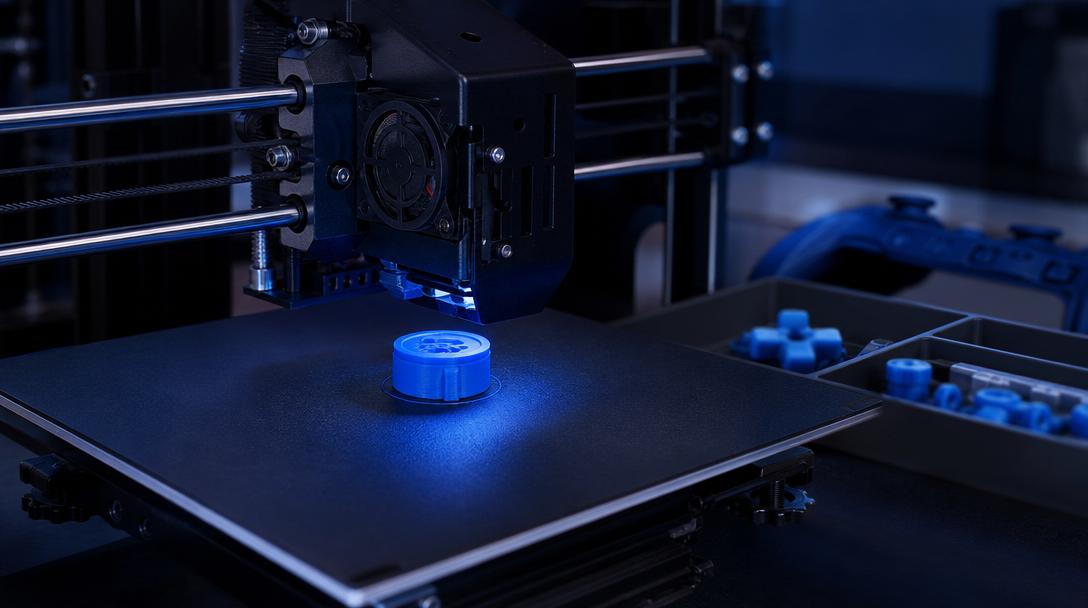
What do you do when a small plastic piece on a home appliance breaks? Often the manufacturer no longer produces that part, or because of a minimum order quantity you end up having to buy a whole new machine just for a single button. This is exactly where spare part 3D printing comes into play. Using measurements taken with a caliper, a model of the broken part is created and reproduced on an FDM printer within hours. What is more, this solution is no longer just for home use; it is increasingly preferred at industrial scale as well.
Spare Part 3D Printing in Everyday Life: From Appliances to Furniture
A washing machine knob, a dishwasher rack wheel, a vacuum cleaner brush head… These are the parts that break most often at home and for which finding the original is almost impossible. If the original spare part is out of stock, the manufacturer may suggest replacing the entire module, which is an unnecessary expense. Yet measuring the dimensions of the broken part with a caliper, modeling it in simple CAD software and printing it in PLA or PETG is just a few hours’ work. By uploading your STL file and instantly calculating its price you can have this part produced at professional quality.
Spare Part 3D Printing at Industrial Scale: Two Recent Examples
Spare part 3D printing is now on the radar not only of hobby workshops but also of large industrial organizations. Siemens Mobility recently standardized the use of FDM spare parts in its maintenance workshops and, together with the Henkel-Wurth Group, developed a certified family of carbon fiber reinforced PETG filaments. This step guarantees the reliability of 3D printed parts in railway maintenance, paving the way for industrial use. Another notable development came from the DLA Columbus Product Test Center in the United States. The center began producing custom test fixtures with FDM printers within hours instead of a procurement process that took weeks. Such applications show how critical a role spare part 3D printing can play in industrial maintenance processes.
The Advantages of Spare Part Production With FDM
FDM technology offers three important advantages in spare part production:
- Low cost: Because there is no mold cost, even a single part is economical. Once the digital file is ready, printing is completed within hours.
- Wide material choice: Materials such as PLA for indoor use, ASA or PETG for outdoor use, and nylon and polycarbonate for high strength can be used.
- Reverse engineering compatibility: An exact copy of an existing part can be produced by 3D scanning or by measuring it with a caliper.
Points to Watch in Spare Part Design
When reproducing a part, taking the original dimensions exactly is usually not enough. In FDM printing, parts can shrink by 0.2-0.5% due to material shrinkage and layer tolerance. For this reason it is necessary to leave a 0.2-0.4 mm clearance in interlocking parts, and to slightly enlarge the hole diameter for screwed connections. You can find more detailed information on this topic on our advantages of 3D printing in prototyping page.
As you can see, spare part 3D printing is a solution that works at every scale, from a broken knob in the kitchen to railway maintenance workshops. If you too have a part that needs to be produced, upload your file and get a quick quote from our online order page.



 Türkçe
 العربية
 Русский
 فارسی
فارسی Deutsch