
Post-Processing in 3D Printing: Why Solukon’s New Software Puts Planning First on Complex Parts
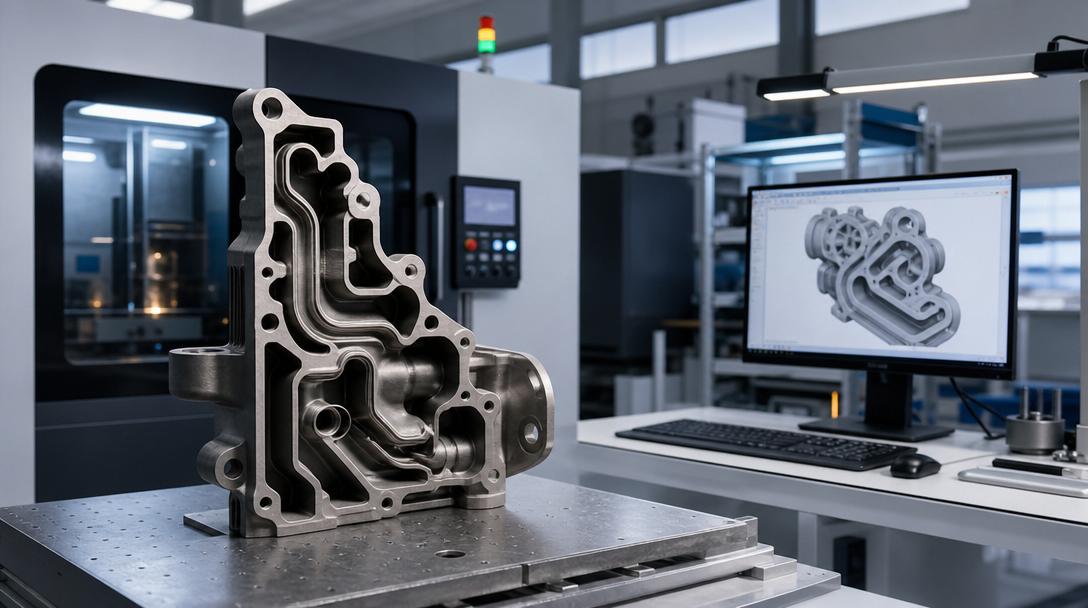
Post-processing in 3D printing now defines success on complex 3D printed parts not just by whether the print comes off the bed, but by the cleaning, access, and assembly planning considered from day one of the design. The new SPR-Pathfinder PRO release that Solukon announced on June 22 clearly shows why this approach becomes critical, especially for internal-channel and hard-to-reach geometries.
According to TCT Magazine, Solukon updated its depowdering software for metal powder bed fusion parts with higher simulation resolution, process time estimation, and the ability to validate designs at the design stage. Even though the news belongs to the LPBF world, the message is familiar to every additive manufacturing user, including FDM: the more complex the part, the earlier you must plan for cleaning, access, orientation, and serviceability after printing.
This point matters for Ucuz3D customers too. When designing an enclosure, a fixture, an air duct, a jig, or a low-volume spare part, focusing only on the question “can it be printed?” is often not enough. How the part will later be cleaned, how supports will be removed, whether connection areas are accessible, and which surfaces are critical during assembly are just as decisive as print time. This planning gains even more value for functional prototypes, especially if you are considering printing with engineering materials.
When we translate the “design for depowdering” approach Solukon emphasizes to the FDM side, the following questions stand out in practice:
- Do internal cavities and channels allow for cleaning after printing?
- Does the part orientation unnecessarily increase the need for supports and degrade surface quality?
- Has safe access been left for sanding, deburring, or minor revisions before assembly?
- Was the first iteration set up with the logic of a testable prototype rather than treated as the final product right away?
These questions become especially important in low-volume production, because even a single small geometry error can extend delivery time and create the need for a reprint. For example, with electronics boxes, assembly jigs, or field-type spare parts, if screw access, clip flexibility, and cable routing are not considered early, the model can look correct on paper yet cause problems in use. That is why this current news offers a design lesson that can be applied not only to large industrial systems but also to everyday prototyping discipline.
For this reason, the real value of the news is not just that it is a software launch; it is a reminder of how design decisions in 3D printing determine the workflow after printing. We do not do metal depowdering, but the same logic applies in FDM production: designs that reduce post-print surprises mean faster delivery, fewer revisions, and more predictable cost. Especially for urgent prototype or field-type spare part needs, simplifying the model early often provides the biggest time savings. If you have a suitable part, you can start the process via the request a quote now link.
If you want to look at the topic more technically, the How Does Print Orientation Affect Part Strength? guide in our Knowledge Center sums up nicely why design is not just geometry but a production strategy. In short, Solukon’s latest move shows that even at industrial scale, the definition of a “good part” is not complete without considering post-processing in 3D printing. If you too want to evaluate the geometry, access, and use scenario together before sending a functional part to print, it is possible to start on the right path with a short, no-pressure preliminary review.


 Türkçe
 العربية
 Русский
 فارسی
فارسی Deutsch