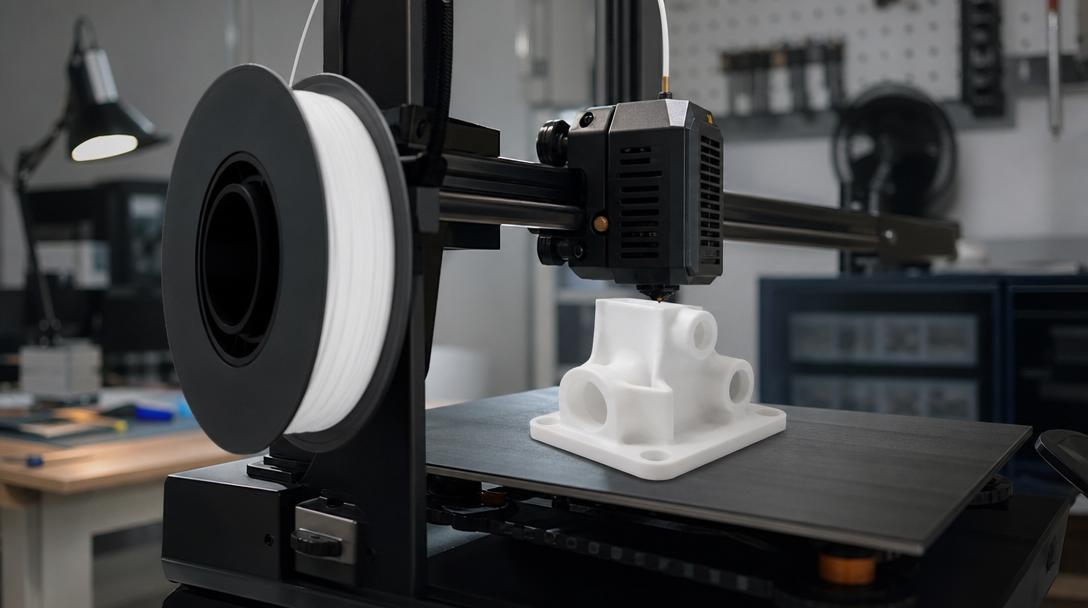

A New Step for Rapid Prototype 3D Printing: What Does Prusament PLA High Speed Promise?
Announced by Prusa Research on 22 June 2026, Prusament PLA High Speed stands out as a new FDM filament that directly answers the need for rapid prototype 3D printing. The short version: it aims to shorten print time on jobs where you need to check form, dimensions and fit before committing to a final load-bearing part — in other words, a noteworthy development especially for concept models, test fixtures and early-stage product validation.
According to the technical framework Prusa has shared, this new PLA variant works with a higher flow characteristic than standard Prusament PLA. On the CORE One+, the maximum volumetric flow is set to 28 mm3/s at 220 °C, whereas the same figure for classic Prusament PLA is given as 24 mm3/s. The company also says that, depending on the model’s geometry and the hardware, print time savings of roughly 20% to 40% can be seen. A gain like this matters most in prototyping, where a part is tested across multiple iterations.
On the Ucuz3D side, the practical meaning is clear: when a customer first wants a quick draft part in hand, a dimensional check or to see how an assembly fits, high-speed PLA-class materials can speed up the workflow. If the final product calls for outdoor exposure, heat, impact or long-term mechanical load, different materials naturally come into play; but in the first validation round, speed is often critical. If you have an urgent prototype or sample need, the request a quote now page is the right starting point for this kind of time-sensitive work.
What makes the new filament notable is not just speed. Prusa states that the material’s layer-to-layer adhesion has also been improved, so even fast prints can deliver more consistent results. The anisotropy coefficient given in the technical documentation is 0.60, which shows it targets strong layer strength within its own material family. For the user, this means that even a part with a “draft print” look is not just a visual mock-up but a more serious prototype on which basic functional checks can be performed.
Another important point is surface character. Prusa clearly states that this filament is not as matte as classic PLA and gives a glossier surface. This can be an advantage for some visual prototypes; however, a glossy surface can also make small print marks more visible. So it is suitable when the goal is to decide quickly rather than achieve showroom-quality surfaces; if final aesthetics are the priority, classic PLA or other material choices remain on the table. If you want to see which option fits different FDM scenarios at Ucuz3D, it is worth looking at the differences among our 17 material options.
This development also shows that the “one material does it all” mindset is weakening on the FDM side. Instead of printing a part once with the single most accurate material, users now plan more systematically: first validate the form with fast PLA, then move to PETG, ASA or other engineering-focused filaments if needed. Especially in product development, electronics enclosures, fixtures and desktop prototyping, this two-stage approach can reduce wasted time. To see why this approach has become so widespread in a broader context, the Advantages of 3D Printing in Prototyping guide is also a good complementary resource.
In short, Prusament PLA High Speed shows that speed-focused prototyping in the FDM ecosystem is evolving into a more refined material class. If your priority is fast test parts, dimensional checks and quick reprints, this news matters. If you also want to clarify whether a model is suitable for prototype printing, a short technical summary sent to us is all we need.



 Türkçe
 العربية
 Русский
 فارسی
فارسی Deutsch