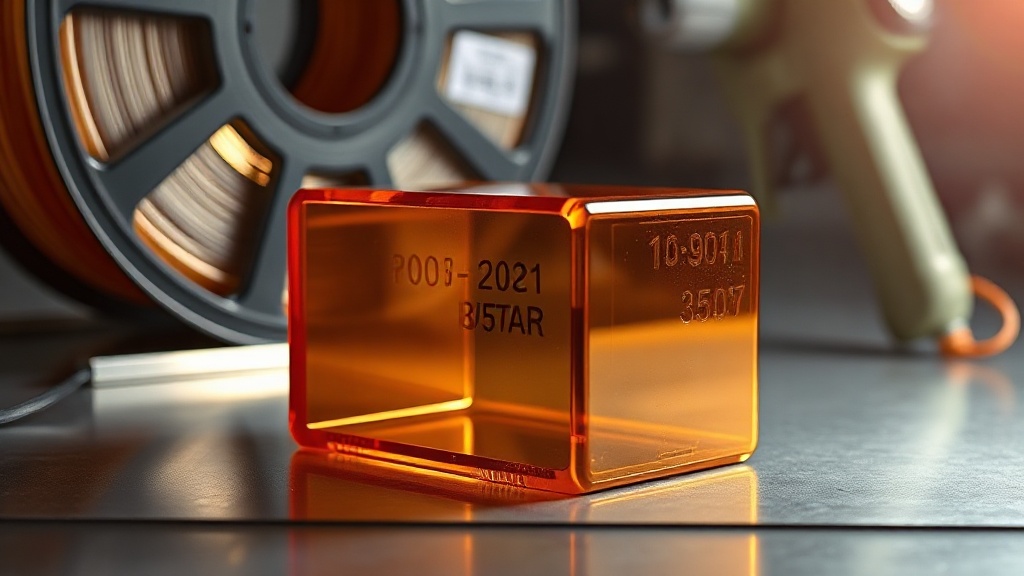

Polycarbonate (PC) Filament: The Most Heat- and Impact-Resistant Option
When a part needs to withstand both temperatures above 100 C and sudden impacts at the same time, the first material that comes to mind is usually polycarbonate filament. PC is one of the engineering plastics that ranks at the very top in the FDM world for mechanical strength and heat resistance. In this post we explain what polycarbonate actually offers, where it makes a real difference, and what to watch out for during printing — from a realistic perspective.
PC’s standout properties
PC is a high-toughness thermoplastic with a glass transition temperature of around 145 C. This means it maintains dimensional stability in heat-exposed environments and absorbs energy under impact rather than fracturing easily. It steps in precisely where PLA or PETG fall short in most applications.
- High heat resistance: Suitable for hot environments such as motor-adjacent parts and lighting housings.
- Superior impact resistance: Resistant to cracking under heavy stress.
- Good dimensional stability: Largely retains its shape across temperature variations.
- Transparent options: Certain PC grades are preferred for parts requiring light transmittance.
What to watch out for during printing
PC’s strengths also make it a challenging material to print. It typically requires a nozzle temperature of 260–300 C and a high bed temperature. Because it is highly prone to moisture absorption, drying before printing is almost mandatory; otherwise bubbles on the surface and a loss of strength will be observed.
Warping and adhesion
PC tends to warp due to shrinkage as it cools. An enclosed chamber printer, a heated bed, and suitable adhesion solutions reduce this risk. For this reason, equipment and parameter compatibility in polycarbonate prints is just as important as the material itself.
Which parts should it be used for?
If the part you are designing will face demanding conditions in terms of heat, mechanical load, or impact, PC is a sound investment. For decorative or lightly loaded parts, easier-to-print materials are usually sufficient. Choosing the right material starts with clarifying your expectations and the operating environment.
At our Şile workshop we print with polycarbonate and a range of other engineering filaments. If you are unsure which material is right for your project, you can share your model and request an evaluation via our quick order page. Let’s determine the right solution for your durable parts together.


 Türkçe
 العربية
 Русский
 فارسی
فارسی Deutsch