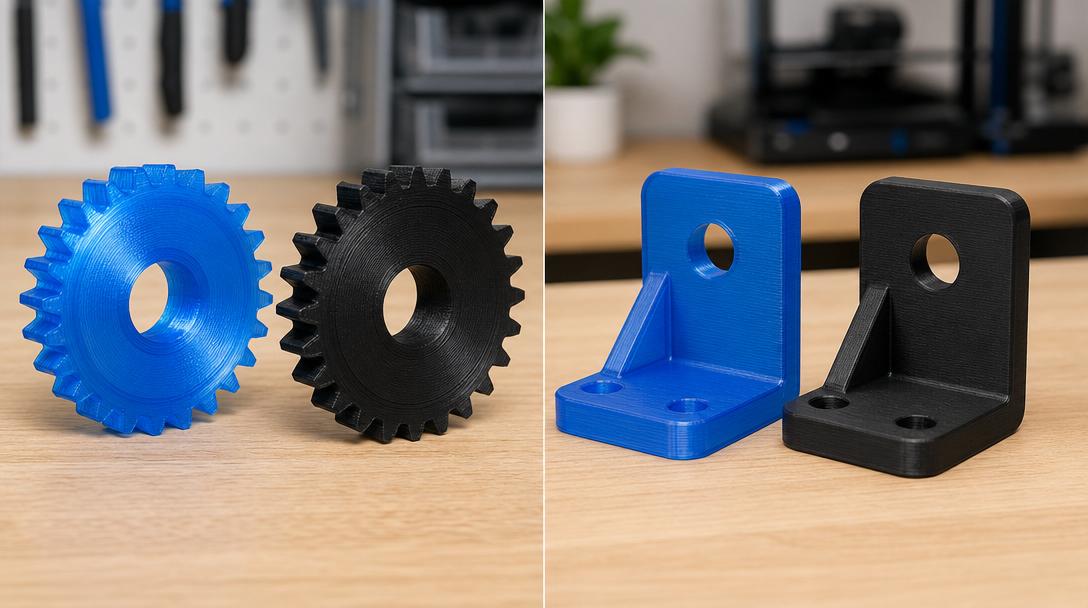

PETG or ABS? The Right Choice for Functional Parts
One of the most common dilemmas when choosing a material for functional 3D printed parts is the question of PETG or ABS. Both materials offer more durable options than PLA, but they have different strengths in terms of toughness, heat resistance and ease of printing. The short answer: if you are looking for toughness and trouble-free printing, PETG is the right choice; if you need high temperature resistance and post-processing, ABS is the way to go.
The Strengths of PETG
PETG stands out as a material that combines the ease of printing of PLA with the durability of ABS. Printed at roughly 230-250 deg C, PETG can be processed comfortably on standard FDM printers because it does not require an enclosed chamber. Its most important advantage is its toughness: PETG parts are resistant to impact and layer separation is seen less often than with ABS. Unlike ABS, it also does not release a strong odor during printing, which makes it easier to use indoors. PETG is ideal especially for enclosures exposed to light impact, brackets and parts that will work in humid environments.
The Strengths of ABS
ABS is one of the most established engineering materials in FDM printing. Printed at roughly 220-250 deg C, the biggest advantage of ABS is that it can withstand heat up to about 100 deg C. This makes it indispensable for engine bay parts, automotive interior components and functional parts that will operate in hot environments. ABS can also be smoothed with acetone vapor; this allows layer lines to be completely eliminated, producing a glossy, professional surface. The biggest challenge with ABS is that it is prone to warping (edge lifting) during printing and requires an enclosed chamber.
Comparison Between PETG and ABS
- Ease of printing: PETG is superior. It does not require an enclosed chamber and the risk of warping is low. With ABS, an enclosed chamber and a stable ambient temperature are essential.
- Heat resistance: ABS is superior (~100 deg C). PETG withstands up to ~70-75 deg C.
- Toughness and impact resistance: PETG is tougher and layer separation is less common. ABS is harder but can be brittle if layer bonding is weak.
- Chemical resistance: ABS is more resistant to oils and solvents. PETG is sufficient against water and mild chemicals.
- Odor: PETG is almost odorless. ABS releases a strong plastic smell and requires good ventilation.
- Post-processing: ABS can be smoothed with acetone vapor. With PETG, sanding and painting are more common.
Which One Should You Choose, and When?
- Enclosures and boxes: PETG gives easier and more reliable results. It is ideal for electronics boxes and brackets working indoors.
- Automotive interior part / hot zone: ABS. Temperature resistance and hardness are critical in this scenario; in areas such as the engine bay, ABS is safer.
- Outdoor accessory: Since both are unprotected against UV, ASA is a better choice. PETG and ABS can be used outdoors if protected with paint or a coating.
- Functional prototype: PETG is ideal for a fast and reliable prototype. ABS, on the other hand, offers mechanical properties closer to the final product.
- Gears and wear parts: Because ABS is harder, it has an advantage over PETG on gears and wear surfaces. Nylon (PA) is an even better alternative in this scenario.
If you are not sure which material is suitable for your project, you can review our PETG, ABS and other durable filament options on our engineering materials printing page. If you wish, you can upload your STL file to instantly calculate the price and place your order with the advantage of delivery within 1 business day. To examine the differences between PETG and ABS in more detail, you can also check out our PETG guide.



 Türkçe
 العربية
 Русский
 فارسی
فارسی Deutsch