
Nylon (PA) or PVA? Functional Part or Water-Soluble Support?
The answer to the question Nylon (PA) or PVA starts with recognizing that these two filaments do not serve the same purpose. Nylon is a material considered for functional parts under suitable design and printing conditions, while PVA is mostly used as temporary support during printing. The choice should therefore depend on whether the part will bear a load and whether the model has geometry that requires support.
When does nylon make sense?
Nylon (polyamide, PA) can be preferred for mechanical parts and some applications subject to repeated movement. However, the material name alone does not guarantee performance. The type of PA, the part’s geometry, print orientation, how the layers relate to the load, and the operating environment all affect the result. Since nylon can absorb moisture, it is also important to store the filament appropriately and assess its condition before printing.
Because of these properties, PA may be a candidate for a connector, slider, or functional prototype, but the conditions of use should be clearly defined. If the part will be subject to continuous load, friction, or impact, producing a sample and testing it under real conditions is more reliable than deciding based on the material name alone. For more information on different applications, see the nylon (PA) filament guide.
PVA’s role: supporting the print, not the part
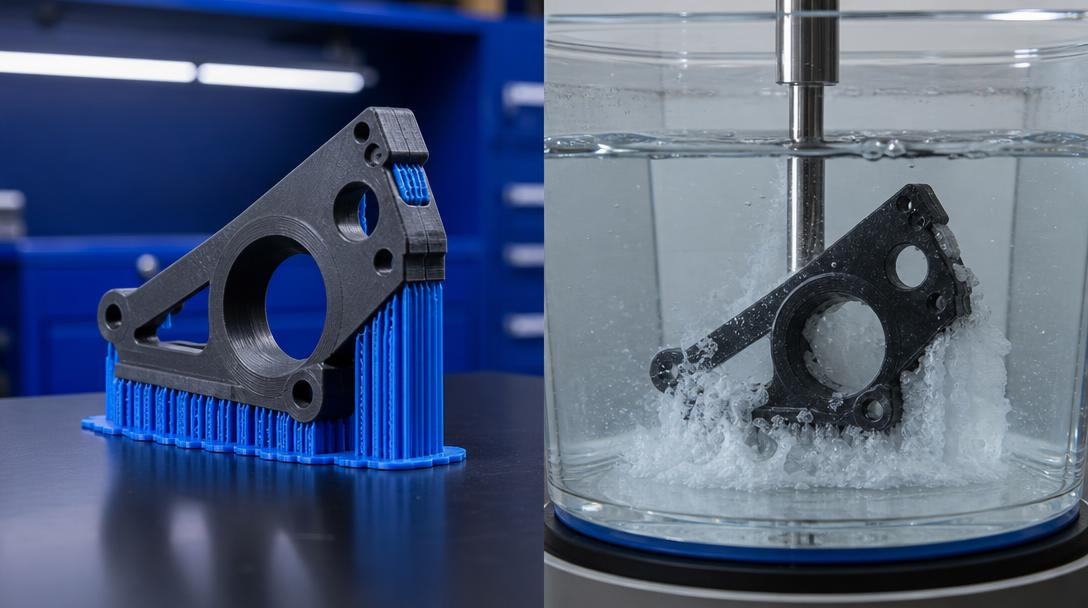
PVA is a water-soluble filament and is mostly used to create temporary support for complex FDM models. Once printing is complete, the support material can be dissolved in a suitable water bath and removed from hard-to-reach surfaces. Compared with manually breaking off support beneath narrow internal channels or complex overhangs, this approach can help protect the surface more effectively.
It is not advisable to think of PVA as the material for a load-bearing final part. Its solubility in water places a significant limitation on the environments in which the finished part can be used. Multi-material printing compatibility, how the support and main materials work together, and the dissolving step should also be included in the print plan. For more context, see the guide to water-soluble PVA and HIPS support materials.
What to check when making your decision
- Part function: PA can be considered for a component that will bear a load; PVA is generally used for temporary support.
- Geometry: Internal cavities and complex overhangs can make PVA support useful. For simple parts, reducing support through design may be more practical.
- Environmental conditions: Moisture should be considered for PA; contact with water limits the use of PVA because of its solubility.
- Printing workflow: PVA requires multi-material printing and subsequent dissolving; with PA, filament preparation and suitable printing conditions are important.
- Part strength: Orientation and geometry matter in both cases. Consider the effect of print orientation on strength.
In summary, nylon may be suitable when mechanical function and appropriate environmental conditions are involved; PVA is relevant when a complex model needs temporary support. Neither is directly “better” than the other; they serve different purposes. When looking for a 3D printing service for your project, you can consider the material and intended use together. Check the estimated cost of your file with the 3D printing price calculator; you can also see the instant 3D printing price on the same page. If the design, environmental conditions, and loads are not yet clear, make a note of them in advance so they can be assessed before printing.



 Türkçe
 العربية
 Русский
 فارسی
 Deutsch