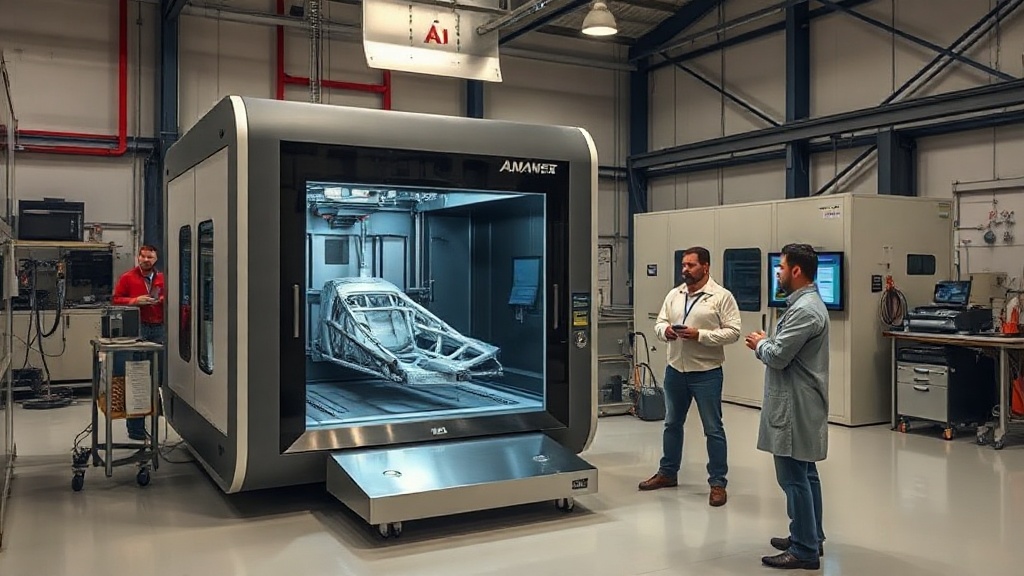

Norsk Titanium and Airbus Move to Standardize 3D Printed Titanium Parts in Aviation
3D printing in aviation is no longer discussed only under the heading of rapid prototyping. According to a TCT report dated 3 June 2026, Norsk Titanium and Airbus have expanded their collaboration with a new research and development agreement, following a lower-fuselage connection part produced for the Airbus A350. The real significance of the news is the acceleration of the standardization process needed for 3D printed titanium parts to be used in commercial aircraft in a more regulated, verifiable and scalable way.
Why is this agreement drawing attention?
The fact that a part produced with Norsk Titanium’s Rapid Plasma Deposition (RPD) technology has flown on the A350 platform shows just how far additive manufacturing has come in aviation. But the truly critical threshold is not a single part flying; it is material qualification, process validation and the institutionalization of a production standard. The new agreement with Airbus focuses precisely on these three areas. In other words, the industry has moved beyond the question “can this part be made?” to “can this method be brought onto the production line repeatedly at the same quality?”
This shift reveals the real value of 3D printing in fields like aviation, where the tolerance for error is extremely low. Advantages such as part lightweighting, shorter lead times and improved material efficiency are not enough on their own; production must be documentable, traceable and compliant with certification. As you can also see on Ucuz3D’s 3D printing solutions for aviation and aerospace page, what this sector expects is not merely to print a part, but to choose the right production approach.
Which areas will Airbus and Norsk Titanium focus on?
According to the information reported by TCT, the new collaboration is built on the technical qualification of titanium wire material, industrial process validation and the development of production methodologies compliant with Airbus standards. The work also aims to expand toward more demanding applications such as fatigue-critical structural elements. This shows that additive manufacturing is on its way to becoming one of the main production tools in aviation, rather than just a supporting method.
The important lesson here from Ucuz3D’s perspective is this: even though the news comes from the metal DED ecosystem, the need for standardization in production applies just as much on the FDM side. Especially with jigs, assembly fixtures, test parts and lightweight prototypes, the right design rules, repeatable print parameters and material selection directly affect overall quality. If you want to see an initial cost framework for your own design, you can upload your model and get a quick preliminary assessment with the instant price calculation approach.
What does this development tell 3D printing users?
This news delivers three clear messages, especially for engineering teams:
- Certification-focused thinking is on the rise: 3D printing now means not just geometric freedom but also process discipline.
- Material knowledge carries strategic importance: titanium wire, process stability and quality monitoring are handled together.
- Scalability will be decisive: instead of a single good sample, the production chain that can deliver the same result in series wins.
That is why it is important for teams working on the desktop or service side to correctly grasp the fundamental additive manufacturing concepts. If you want to draw clear distinctions between these concepts, the Additive Manufacturing Glossary in the Ucuz3D Knowledge Center offers a good starting point. Reading terms like metal DED, FDM, tolerance, qualification and process traceability correctly allows you to interpret the news more effectively.
What is the practical takeaway for Ucuz3D?
Certified titanium parts in commercial aviation and FDM service printing are not in the same league; however, what they have in common is that production decisions are made with data. For teams developing products in Turkey, this type of news shows that the path from prototype to functional fixture now needs to be structured more systematically. When the right material, the right print orientation and the right use-case scenario are chosen, FDM printing remains a very powerful tool for test fixtures, assembly aids, enclosures and low-volume functional parts.
If you are not sure how to position an aviation, automation or engineering-focused part with FDM, you can clarify the most suitable approach by sharing your project along with its technical requirements. That way you can make a healthier start in terms of cost, lead time and feasibility alike.




 Türkçe
 العربية
 Русский
 فارسی
فارسی Deutsch