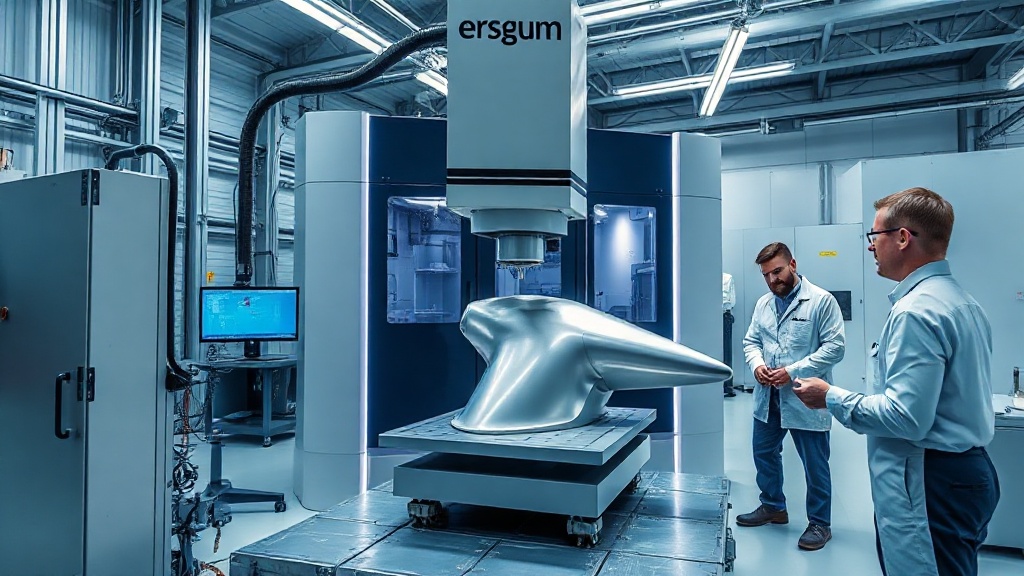

Massivit Expands Its 3D Printing Push in U.S. Defense and Aerospace
Massivit 3D printing has made headlines again — this time with news that will catch the attention of firms considering large-scale production for defense and aerospace projects. The company’s decision to reinforce its advisory board in order to deepen its defense and aerospace focus in the U.S. market shows that 3D printing is rising to a strategic position not only in prototyping but also in production readiness and tooling. For teams dealing with tight deadlines, large geometries, and complex tooling needs, this development is an important directional signal.
Why are large-volume parts back on the agenda?
On the industrial side, a significant share of production delays does not originate in the part itself but in the molds, fixtures, gauges, and auxiliary manufacturing equipment required before the part can be made. Large-scale 3D printing systems can offer a substantial time advantage over conventional methods in this area. This approach is becoming increasingly valuable for teams that need to iterate quickly on composite molds, mock-ups, assembly aids, and temporary tooling.
Massivit’s move closer to the U.S. defense and aerospace community makes perfect sense in precisely this context. Because in these sectors, it is not only the strength of the final part that matters — lead time, supply-chain flexibility, and the ability to produce low-volume custom parts are equally critical.
What does this step mean for defense and aerospace?
The company’s decision to bring an experienced defense professional onto its advisory board should be read as a search for field alignment rather than a marketing move. In defense programs, technical capability alone is not enough for a manufacturing technology to gain acceptance; communication with program offices, quality expectations, certification approaches, and supply-chain confidence are also required. A management move of this kind therefore suggests that 3D printing is being taken more seriously at the decision-making level.
- Production of large-format molds and auxiliary equipment can be accelerated.
- Lead times for low-volume custom production can be shortened.
- A more agile production model that responds to design changes can be established.
- Parts that are expensive to produce by traditional machining can shift to a hybrid model.
What is the takeaway for manufacturers in Turkey?
This news should not be read merely as a foreign company announcement. For the many teams working in Turkey’s defense, automotive, robotics, and aerospace supply chains, the message is clear: 3D printing is moving beyond being a prototype technology kept only for the showroom. In particular, large-volume auxiliary parts, fixtures, and verification models based on FDM can generate considerably more value. Ucuz3D’s defense-focused 3D printing approach is precisely the field-level embodiment of this agility.
The real opportunity lies in the pre-production layer, not the final part
Many companies still evaluate 3D printing through the lens of “printing the final product.” Yet real efficiency most often emerges at the production-readiness layer: fixtures, assembly aids, trial molds, ergonomics check models, or short-life tooling. This is where the significance of this news lies. In high-cost sectors such as defense and aerospace, every tool that shortens preparation time translates directly into a competitive advantage.
Especially for large-format molds and composite production-readiness stages, compressing what would otherwise be weeks of conventional procurement into a matter of days can sometimes determine the fate of a project. That is why tracking where systems like Massivit are being positioned matters not only out of technology curiosity but also from a production-planning perspective.
If you too would like to see how 3D printing could be integrated into your production process for large-volume or custom-purpose parts, you can share your project via our quick quote page and receive a clear preliminary assessment on the right material and production approach.




 Türkçe
 العربية
 Русский
 فارسی
فارسی Deutsch