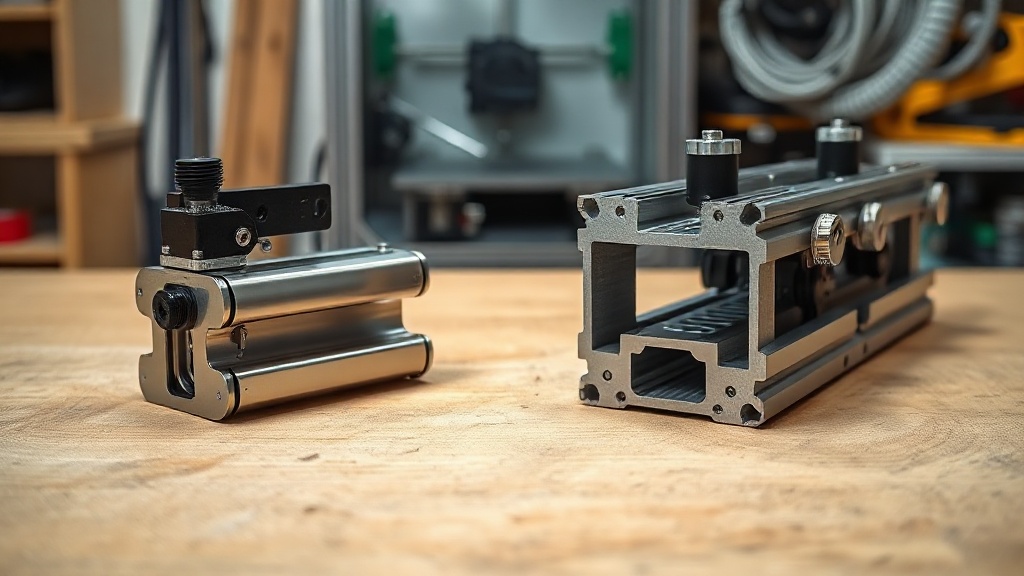

Linear Rails vs POM Wheels: Motion System Upgrade Guide
If you’re seeing repeating lines along an axis, slight corner rounding, or dimensional accuracy that degrades over time, the culprit is usually not the filament — it’s hiding in the printer’s motion system. One of the most debated topics at this point is whether to go for a linear rail upgrade or stick with the factory POM (Delrin) wheel system. Both have their place; the right choice depends on your machine and your expectations.
Why is the POM wheel system still so common?
Most entry-level and mid-range FDM printers use POM wheels running on V-slot extrusions. They are quiet, inexpensive, and tension is easily adjusted with an eccentric nut. However, because POM is a soft material it wears down over time; once the wheels start to develop flat spots, backlash appears on the axis and print quality drops.
Weak points of POM wheels
- Periodic tension re-adjustment is required as the wheels wear.
- Flex and ringing can appear during high-speed printing.
- Dust accumulation on the extrusion increases friction and accelerates wear.
What does a linear rail upgrade actually give you?
Linear rails work by sliding a ball-bearing carriage block along a precision steel rail. The biggest advantage they provide is rigidity and repeatability. The bed and print head flex far less, which means sharper corners and cleaner surfaces — especially at higher print speeds.
- Very low backlash leads to improved dimensional consistency.
- Rails such as MGN9 and MGN12 increase load-bearing capacity.
- With proper installation, maintenance intervals are extended.
That said, linear rails are not a magic fix. Low-quality rails run rough, and if the mounting surface is not flat they will bind the rail and actually introduce vibration. Additionally, cost and installation effort are noticeably higher than with POM wheels.
Which one should you choose?
For hobby-grade, moderately accurate prints, a properly maintained POM wheel system will serve you well for a long time. However, if dimensional accuracy on functional parts is critical, you are printing at high speed, or your toolhead weight has increased, a linear rail upgrade will pay for itself. The most sensible approach is usually to convert the most heavily loaded axis — X or Y — to rails first.
If you need high-quality, dimensionally consistent parts without the hassle of hardware upgrades, you can request a quote for prints produced on our calibrated machine fleet via our quick order page. Tell us about your project and we’ll find the best solution together.


 Türkçe
 العربية
 Русский
 فارسی
فارسی Deutsch