
In-Hospital 3D Printing: What PolyUnity’s Workflow Teaches Us About Medical Prototyping
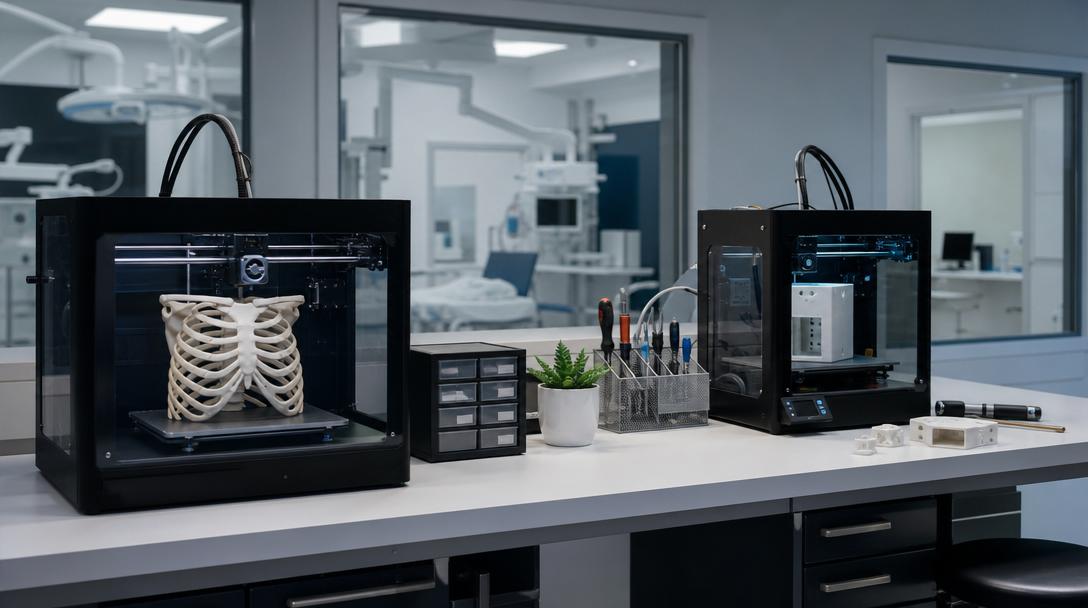
The in-hospital 3D printing approach aims to develop a needed part or model faster, without getting stuck in an external supply chain. The PolyUnity-focused news from 2 June 2026 illustrates exactly this: when a clear workflow is built from idea to final product, medical teams can move far more nimbly when producing training models, fixtures and patient-specific helper parts.
The PolyUnity approach featured in 3D Printing Industry treats in-hospital 3D printing not merely as “running a printer,” but as a chain of needs definition, clinical feedback, rapid prototyping, revision and a suitable end-use scenario. This perspective matters especially in the medical field, because here the real value comes less from producing the file and more from validating the right part at the right speed.
Why does this story matter?
On the medical side, not every part has to become a final patient product. For training models, procedure simulations, device holders, enclosures, organizational fixtures and low-risk helper components, rapid iteration offers a major advantage. Looking at it through the lens of Ucuz3D’s medical and dental 3D printing solutions, the key takeaway is exactly this: FDM-based production offers a practical bridge especially for training, prototypes and helper parts that make operations easier.
The PolyUnity example shows that an in-house 3D printing workflow rests on three critical points: defining the need correctly, completing small revision cycles quickly, and moving into production only for genuinely suitable use cases. This logic applies to hospitals as much as to medical startups and device teams developing products.
What lesson should Ucuz3D draw from it?
The main lesson here is that not every medical request should be placed in the same category. The areas that can be safely handled with FDM are generally these:
- anatomical training and explanatory models
- around-the-device helper fixtures and assembly supports
- protective enclosures, carriers and boxes
- prototype validation and ergonomics tests
- low-volume process improvement parts
By contrast, regulated final implants, advanced biomaterials or custom parts in direct clinical contact are a separate area of expertise and regulation. That is why the value of this story lies not in a “let’s 3D print everything” message, but in the idea of validating the right job faster with the right technology.
If a medical team wants to develop a new fixture, enclosure or training model, running a small prototype round first is the healthiest step. In such cases, a low-volume trial production can be planned with a request a quote now approach. To see what to watch out for as a design goes from its first version to the final result, the 3D Printing in the Medical Field: From Prostheses to Surgical Models guide also offers a good framework.
Why is it on the agenda now?
Lately, the common theme in medical 3D printing news has been building a sustainable workflow rather than relying on a single big machine. That is why the PolyUnity example draws attention: the value proposition comes not from the printer, but from in-team coordination and a repeatable process. From Ucuz3D’s standpoint, this approach is a fresh reminder of why fast turnaround for the customer is critical, especially in medical prototyping, training models and functional helper parts.
In short, this story tells us we should read the future of in-hospital 3D printing not just as a technology showcase, but as a model for rapid validation and on-site problem solving. If you have an idea for a prototype or helper part suited to your medical use case, starting with a small trial production is often the right first step.


 Türkçe
 العربية
 Русский
 فارسی
فارسی Deutsch