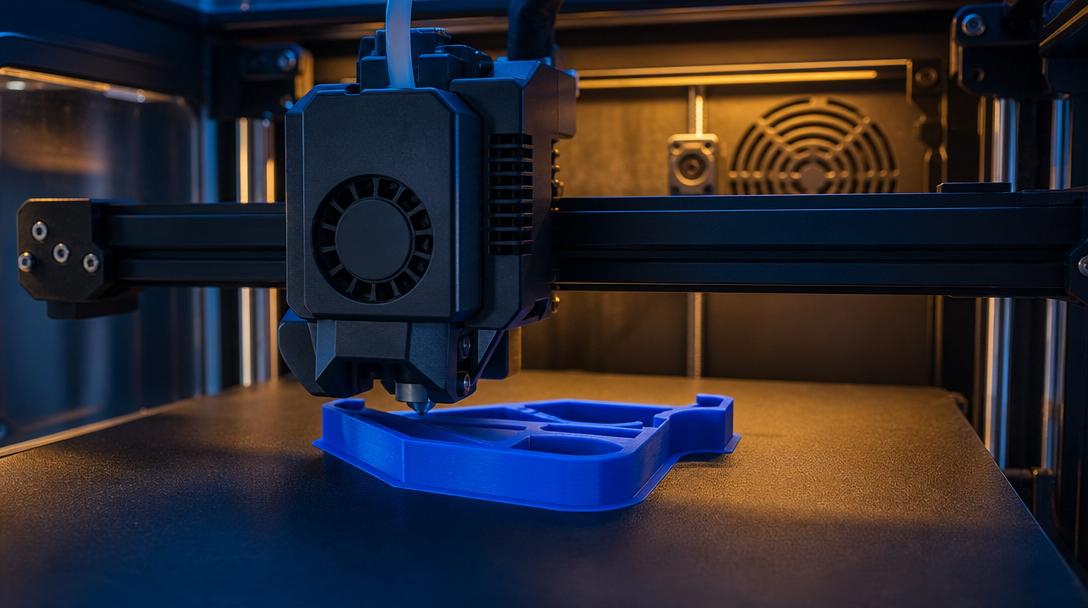

How to Permanently Solve ABS Cracking and Warping Problems
Although ABS is one of the most popular filaments for industrial parts thanks to its durability and heat resistance, the problem of ABS cracking often makes beginners stay away from this material. In this article, we explain step by step why cracking and warping occur with ABS and which measures can eliminate them completely.
Why Does ABS Crack and Warp?
ABS has a much higher glass transition temperature (around 105 °C) than PLA. During printing, the melt that leaves the nozzle at 230-250 °C cools and contracts rapidly in a room-temperature environment. This contraction creates uneven stress, especially in large parts with flat bases:
- Warping: The corners lift up from the bed surface and the part loses its shape.
- Delamination: Due to sudden cooling, the layers do not bond to each other well enough and fine cracks form.
- Internal cracks: In large-volume parts, the inside of the material is still cooling while the surface is already hot; this difference leads to stress cracks.
The root cause of the problem is the difference between the ambient temperature and the melt temperature. When you reduce this difference, ABS prints come out both flatter and crack-free.
The Most Effective Solution: An Enclosure
The surest way to prevent warping with ABS is to run the printer inside an enclosed chamber. When the temperature inside the enclosure reaches around 40-50 °C, the cooling rate slows down and the contraction stress is significantly reduced. To achieve this:
- If your printer has an enclosed case, keep all the panels closed.
- On open-frame CoreXY or Prusa-type printers, you can build a temporary enclosure with plexiglass or acrylic panels.
- For large parts, check the temperature inside the enclosure with a thermometer; 45-50 °C is ideal.
Bed Temperature and Adhesion Measures
Bed temperature is critical for ABS. A bed heated to 100-110 °C ensures that the first layer adheres well to the surface. In addition, the following methods work well:
- ABS slurry: A paste made by dissolving some ABS scraps in acetone is applied to the bed surface as a thin layer. Once it dries, it forms an excellent adhesion surface.
- Garage/blue masking tape: Printing on heat-resistant tape largely prevents lifting.
- PEI surface: Special PEI-coated beds for ABS offer both good adhesion and easy part removal.
- Adding a brim: By adding a 5-10 mm wide brim (a single-layer edge) around the part, you can increase resistance against the lifting force.
Cooling and Print Speed
Unlike PLA, the cooling fan should be kept to a minimum with ABS. Most users turn the fan off completely for ABS, or set it to only 10-20% for very fine details. In addition, keeping the print speed low (40-60 mm/s) helps the layers fuse together better. On large parts, lowering the print speed down to 30-40 mm/s minimizes the risk of cracking.
Another important point: do not remove the part from the bed immediately after the print finishes. Wait for the bed to cool down naturally to 50-60 °C. A sudden temperature change can cause cracking even during the cooling phase.
When Should You Consider ABS Alternatives?
If you do not have an enclosure, or if you are sensitive to the smell of ABS (styrene), there are also alternatives that offer similar mechanical properties with easier printing. ASA is a version of ABS with improved UV resistance and warps less. PETG, while it does not offer heat resistance as high as ABS, has almost no cracking or lifting issues. Choosing the right material according to your project’s needs directly affects printing success.
At Ucuz3D, we have extensive experience with FDM printing using ABS and other engineering materials. We support you at every stage, from material selection to print parameters for your project. If you do not want to deal with ABS settings on your own printer, you can upload your STL file to calculate the price instantly and safely receive your print produced with our professional equipment. For more technical details about warping and edge lifting with ABS, you can also take a look at our Knowledge Center guide.



 Türkçe
 العربية
 Русский
 فارسی
فارسی Deutsch