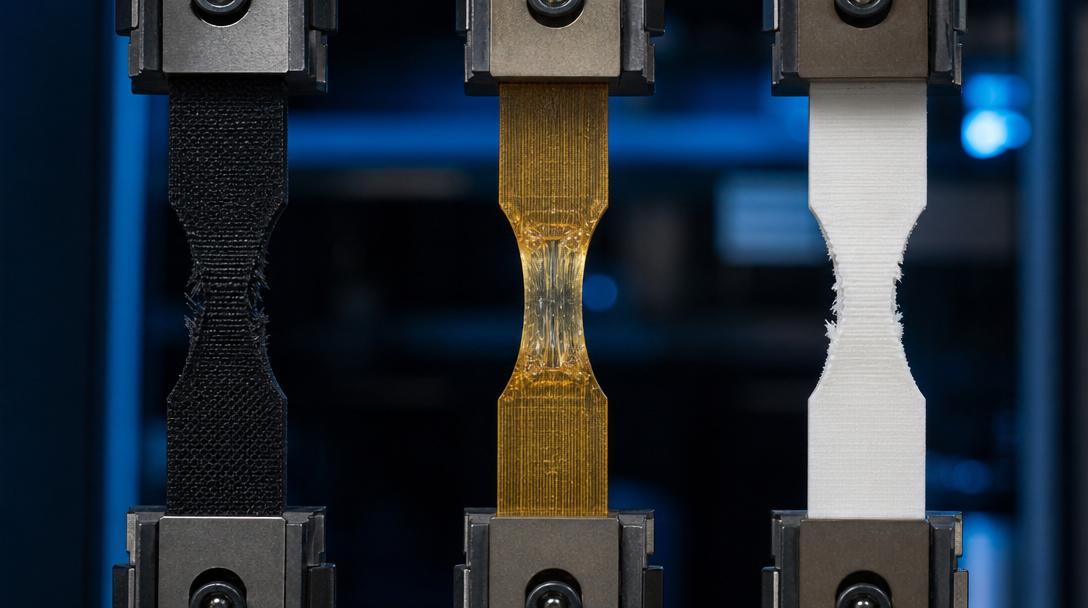

How Durable Are 3D Printed Parts? Which Filament Is the Strongest?
“Which filament is the strongest” is one of the most common questions asked by anyone into 3D printing. Especially when it comes to functional parts, durability depends on many factors ranging from material selection to infill percentage and layer adhesion. In this article, we break down the key factors that determine the strength of FDM printed parts and the toughest filament options available today in plain language.
Factors That Determine Durability
To understand how long a 3D printed part will last, knowing a few basic parameters is enough. We can group them under four main headings:
- Material selection: While PLA is sufficient for everyday use and prototypes, load-bearing parts or those subject to friction require engineering materials like nylon (PA) or polycarbonate (PC). The material directly determines the part’s lifespan.
- Wall count (perimeter): The parameter that most affects a part’s strength is not infill but wall count. 3-4 walls is the gold standard for most mechanical parts. In thin-walled designs, increasing the wall count significantly boosts strength.
- Infill percentage and pattern: Infill forms the internal skeleton of the part. The gyroid pattern provides balanced strength in all directions, while honeycomb is suitable for high vertical loads. 20-30% infill is sufficient for most everyday uses, while over 50% is preferred for engineering parts.
- Layer adhesion: Printing temperature and cooling speed determine how strongly the layers bond to each other. Low temperature leads to weak adhesion, while excessive cooling causes layer separation, making the part brittle.
Which Are the Strongest FDM Filaments?
If we were to rank the most durable filaments available for FDM printing:
- Polycarbonate (PC): The most heat and impact resistant option. It can withstand temperatures up to 110 °C and is preferred for industrial parts that require high impact strength. You can find detailed specifications in our polycarbonate filament guide.
- Nylon (PA): The material with the highest wear and fatigue resistance. Ideal for gears, pulleys, bearings, and mechanical connection parts. You can explore industrial applications on our nylon PA filament page.
- Carbon Fiber Reinforced Filament (PA-CF / PETG-CF): Stands out in precision work requiring rigidity and dimensional stability. You can see carbon fiber reinforced printing options on our engineering materials page.
- PETG: Strikes a balance between PLA and ABS; it’s easy to print while offering good mechanical properties.
- ASA: As the UV-resistant version of ABS, it is preferred for outdoor parts.
Which Filament Should You Choose for Which Part?
The right material choice depends on the operating conditions of the part. For everyday use, low-cost prototypes, and decorative objects, PLA is sufficient. For parts that will operate in hot environments (such as kitchen utensils or near the engine bay), PETG or ASA are more suitable. For gears, brackets, and fasteners that bear high mechanical loads, nylon or polycarbonate is the right choice. It’s also important to assess what kind of load the part will be exposed to in advance: impact, continuous load, or abrasion? If you’re not sure which filament suits your project, you can compare materials and costs with our instant price calculator tool.
Remember: The right material + sufficient wall count + optimized infill pattern + good layer adhesion will multiply the strength of your FDM printed parts. With our transparent per-gram pricing, you can have parts manufactured from engineering materials and receive them in professional quality.



 Türkçe
 العربية
 Русский
 فارسی
فارسی Deutsch