
How Did 3D-Printed Spare Parts Drive Cost Savings in C-17 Maintenance?
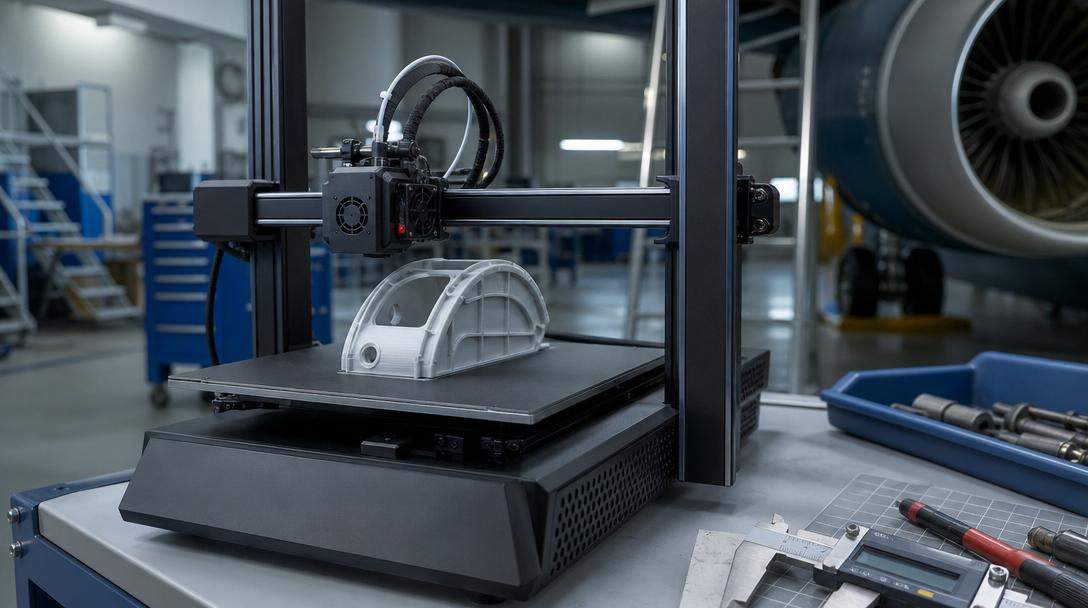
3D-printed spare parts can deliver a serious advantage in maintenance scenarios that call for low volumes but fast turnaround. According to a TCT Magazine report dated June 26, 2026, U.S. Air Force maintenance crews refreshed certain lavatory components inside the C-17 Globemaster III using FDM-based production, cutting the per-part cost by 88 percent.
The key takeaway from the report isn’t just the cost reduction; the time the aircraft spends grounded is also considered critical. The C-17 fleet is used worldwide to carry heavy cargo, equipment and humanitarian aid. According to TCT, with more than 200 aircraft on active duty, even seemingly minor interior part failures clearly show why they matter so much in the maintenance chain.
Why does this news matter?
The real message here is that additive manufacturing can create value not only for prototypes, but also for the small yet critical parts that keep operations running. The report notes that U.S. Air Force maintenance units moved forward with the Stratasys F900 system and Antero 800NA material. This approach offers three important advantages, especially for parts that have long lead times in conventional supply chains:
- eliminating the need for tooling in low-volume production,
- shortening the wait time for spare parts,
- letting maintenance teams act more nimbly as needs arise.
From Ucuz3D’s perspective, the most valuable aspect of the news is this: not every 3D printing application has to be an aviation-certified flight part. The FDM approach can be a very strong solution for maintenance fixtures, protective covers, housings, interior trim parts, test fixtures and similar service components. For work that requires fast validation in particular, the approach on our aviation and aerospace 3D printing solutions page better explains why this news has a practical counterpart.
Where does similar logic pay off in Turkey?
Rather than copying this example exactly, it’s better to read its logic correctly. If a broken or hard-to-source plastic part is slowing down a production line, a field team or a maintenance flow at a business, rapid re-production with FDM can save serious time. Especially for parts that can be measured or for which an old sample exists, a 3D scanning and reverse engineering approach can speed up the process even further.
On top of that, one of the biggest advantages of 3D printing is the ability to apply small revisions without waiting. While conventional manufacturing requires a new mold, new tooling or a new ordering cycle, with FDM details such as wall thickness, a connection feature, a cable outlet or assembly clearance can be updated quickly. This provides important flexibility, especially for service parts, maintenance covers, electronics enclosures or low-volume spare part needs.
Which parts make more sense?
This kind of news can often lead to the wrong conclusion, like “let’s 3D print everything.” Yet the right approach is to choose the appropriate part. Parts that are low-volume, geometrically specialized, require fast delivery and mostly fall into the plastic or polymer class are better suited to 3D printing. Conversely, for end-use parts that involve very high temperatures, heavy chemical loads or regulatory requirements, the material and validation criteria must be assessed more carefully.
That’s why this news is valuable less for technological curiosity than for supply logic. Organizations no longer view 3D printing solely as a sample-production tool; they position it as a manufacturing method that shortens maintenance times, eases inventory pressure and keeps costs under control for small runs. If you’d like to quickly see the cost of a similar part, you can upload your STL file and produce a first estimate with the instant price calculation option.
If you have a housing, fixture or plastic service part that needs to be reproduced, 3D printing can often be a faster alternative than you’d expect. The important thing is to correctly match the part’s operating conditions with the right FDM material.


 Türkçe
 العربية
 Русский
 فارسی
فارسی Deutsch