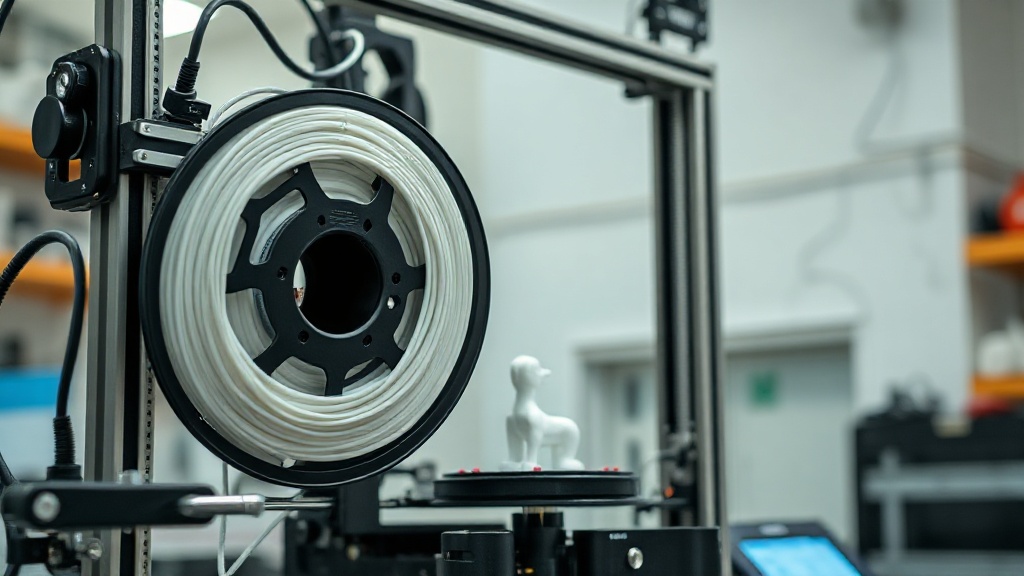

How Could Bambu Lab’s PLA Pure Announcement Change the Way You Choose PLA Filament?
Announced on 18 June 2026 on the PLA filament front, Bambu Lab PLA Pure stands out with its claims of lower emissions, traceable content and a cleaner printing experience. The news shows that, especially for in-office prototyping, educational models and FDM production carried out in environments close to people, material choice is no longer just about looks and easy printing.
According to information published on DEVELOP3D, PLA Pure was developed with a five-component formula, and it was emphasized that each ingredient was separately verified for food contact and indoor emissions. This approach matters, because in the FDM world many users already consider PLA to be in the “easy and safe” category, yet for products close to the end user, educational parts or desktop prototypes, content transparency and the particle/VOC question are increasingly being scrutinized.
Why does this news matter?
PLA has long been seen as the entry-level material for fast prototyping. However, this new announcement reminds us that three topics should be evaluated together when choosing a material: ease of printing, emission behavior and suitability for the application. Especially for teams working in enclosed offices, the promise of cleaner extrusion, less nozzle residue and lower stringing also carries operational value.
What this means is: not every PLA will respond to the same use case in the same way. If your goal is a visual prototype, an educational model, a lightweight assembly fixture or short-cycle product validation, then it is not just “being PLA” that matters, but the formulation and printing character as well. If you want to compare material choices for different applications at Ucuz3D, you can review our 17 material options.
What is the practical takeaway for Ucuz3D?
This development ties directly into the FDM service side. Because a significant portion of customers, when asked the first question, think “which filament is more suitable?”; in the second question they describe where the part will be used. For parts that will be used on a desktop, in a classroom, in a showroom or inside an office, PLA is still a strong candidate. On the other hand, if heat, impact or outdoor durability is required, different filaments may be more appropriate. That is why the material decision should be made according to the actual usage conditions of the part, before the certification and emission claims highlighted in the news.
There is also a critical boundary here: a filament’s content safety or low-emission claim does not mean that every printed part is automatically suitable for all end-use scenarios. Surface structure, print settings, post-processing, contact time and regulatory requirements must also be evaluated. In other words, although the news is promising, the engineering decision must still be made on an application-by-application basis.
What should you look at when choosing PLA filament?
- Usage environment: Will the part sit in a home, office, classroom or workshop?
- Heat load: Will it be used under sunlight, inside a vehicle or near a hot surface?
- Surface expectation: Is a clean surface and low stringing required?
- Reproducibility: Is it important to get consistent results across the same part in series?
If you want to read this framework more systematically when making a PLA choice, the PLA Filament: Properties, Advantages and Areas of Use guide offers a good starting point.
In short, Bambu Lab’s PLA Pure announcement shows that within the FDM ecosystem the concept of “easy printing” is now evaluated together with cleaner production, a more traceable recipe and more predictable results. This is a meaningful signal not only for the hobby side, but also for businesses that commission production for prototypes, educational models, display parts and low-risk functional applications.
If you too want to clarify whether PLA or another FDM material is more suitable for your part, you can share your file and request a quote right away.



 Türkçe
 العربية
 Русский
 فارسی
فارسی Deutsch