
How 3D Scanning and Reverse Engineering Were Used in Newcastle’s Roman Game Board Replica
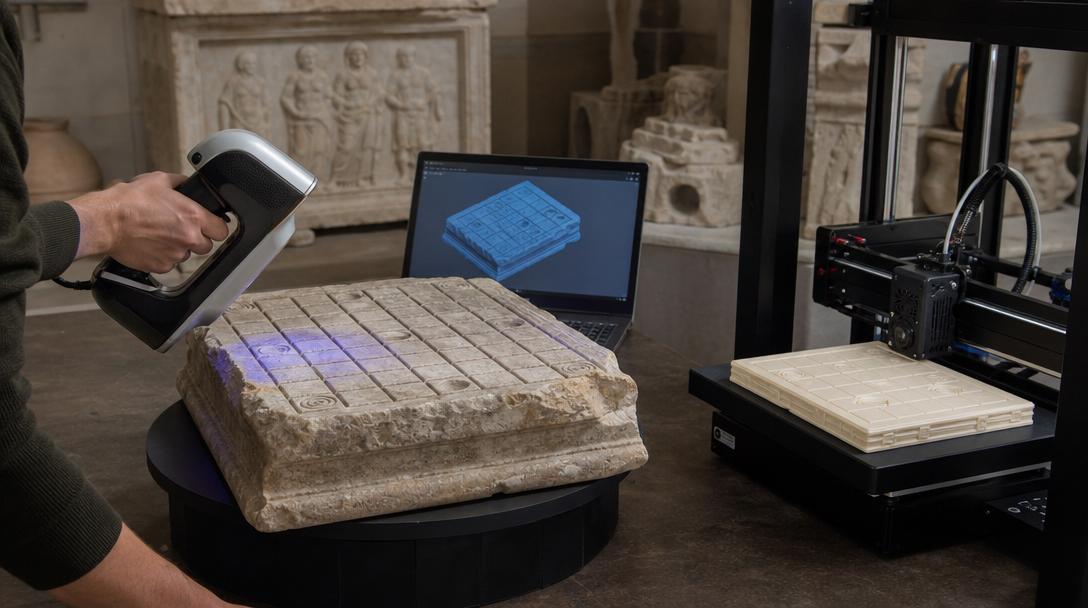
3D scanning and reverse engineering proved directly useful in a project where Newcastle University and the Vindolanda team recreated a Roman-era game board. According to a report dated 20 June 2026, the team scanned the original stone pieces, turned them into a detailed digital model, and then produced a physical replica in PLA, making the artefact something visitors can actually touch.
What exactly happened in the story?
In the project reported by VoxelMatters, a five-piece stone game board found at the Vindolanda excavation site in 2019 was brought to Newcastle University’s engineering team. The pieces were digitised one by one with an Artec 3D Spider handheld scanner; a detailed model was built from the resulting point data and then prepared for printing. In the final stage, this model was reproduced in PLA. An interactive 3D model that visitors can rotate and examine on screen was also prepared.
The key point here is that the process is not merely “artefact copying.” The real value lies in capturing the physical object digitally without damaging it, preserving the geometry information, and being able to reproduce it in a controlled way when needed. The same logic is used today across many production needs, from broken covers to custom fixtures, and from display models to demonstration parts for educational purposes.
Why does it matter on the Ucuz3D side too?
This story is very close to a need Ucuz3D often encounters in the field: when there is no STL file on hand, you first capture the geometry through measurement, photography, or scanning, then create a model suitable for FDM printing. Especially for worn or no-longer-available plastic parts, the broken plastic part 3D printing approach rests on exactly this workflow.
Of course, the Newcastle example is heritage-focused and involves a PLA replica of a stone object; in other words, the method described here does not mean “we produce the same thing in every material.” But the essence of the work does not change: first the right data is collected, then the model is simplified according to the limits of the printing technology, and finally a test- or use-oriented copy is produced in a suitable material. At Ucuz3D, for needs of this type the request a quote now step can be a practical start for quickly seeing whether a part can be produced.
3 practical lessons to draw from this story
- Scanning alone is not enough: Raw scan data must be cleaned, aligned, and converted into a print-ready model.
- Material choice is made according to purpose: The Newcastle team chose PLA for display and interaction; industrial use may require different filaments.
- Speed is a major advantage in replica production: While the original part is being moved or preserved, training, testing, or user interaction can continue through the copy.
What connects this to FDM production?
FDM printing is strong especially in low-volume reproduction, prototype validation, and geometry-checking stages. That is why this story is not just a museum application; it is also a good example of the “digitise first, then produce in a controlled way” approach. If you would like to see more closely how scan data turns into production, Ucuz3D’s 3D scanning and reverse engineering guide summarises the basic steps of this process in a clear way.
In short, the Newcastle and Vindolanda project shows that 3D scanning is a powerful tool not only for archiving but also for reproduction and user experience. If you have a part or prototype that needs to be recreated, starting from the right data and proceeding with a suitable FDM workflow is the safest path.


 Türkçe
 العربية
 Русский
 فارسی
فارسی Deutsch