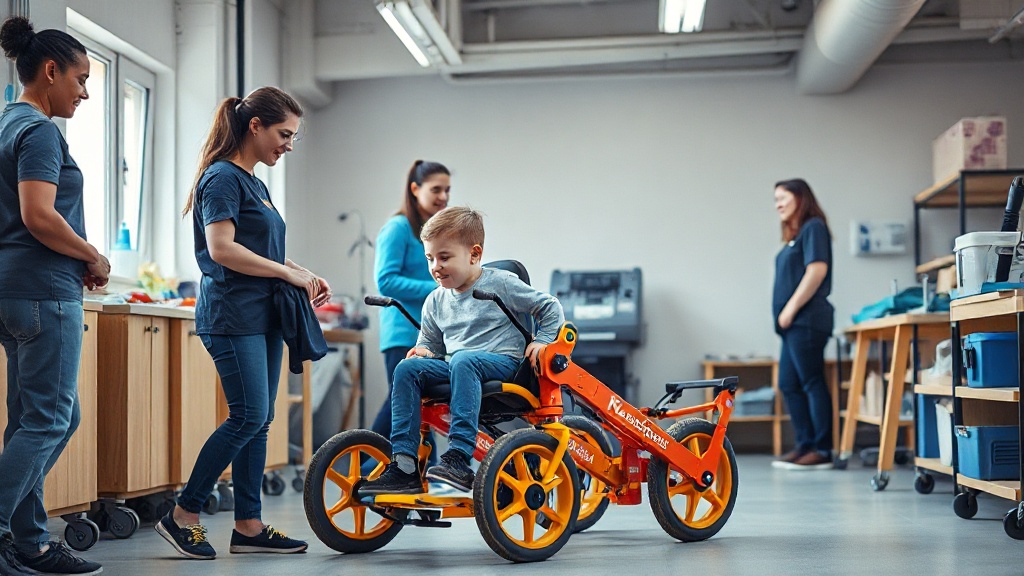

Girl Scout Team’s 3D Printed Child Mobility Aid Project
3D printed child mobility aid — this recent project has put the spotlight on how powerfully technology can be used not just for industrial purposes, but for social good. In the United States, a Girl Scout team used their own fundraising budget to produce a 3D printed mobility solution for a child, demonstrating that accessible design, low-cost manufacturing, and grassroots initiative can all converge at the same point. Projects like this showcase the “personalized solution” side of 3D printing in the most visible way possible.
Why are solutions like this difficult with conventional manufacturing?
Body measurements, weight, usage habits, and safety requirements vary significantly from person to person when it comes to mobility aids developed for children. Standard mass-produced items cannot always comfortably accommodate this diversity. Especially when a solution is needed quickly, on a limited budget, and with measurements closer to the individual, 3D printing offers a significant advantage.
What stands out here is that the solution was not approached with a simple “print it and done” mindset. Adjustable headrests, carrying handles, and user-shaped components demonstrate the true value of personalization.
The power of 3D printing in accessible design
This news also shows that accessible design does not have to be expensive. With the right design file, appropriate materials, and controlled production, many assistive products can become more attainable. Of course, expert assessment is essential in areas that require medical responsibility — but for rapid prototyping and functional testing, 3D printing is an extremely powerful tool.
- Quick measurement adjustments can be made for each user.
- Spare parts or minor revisions can be produced more economically.
- Details such as color, grip points, and accessories can be customized.
- High impact can be achieved on a low budget in community projects.
Moreover, when solutions like these combine with open-source design culture, adapting the same approach to different needs becomes much easier.
What does this mean for socially beneficial production in Turkey?
This news is an important source of inspiration for schools, maker communities, municipalities, and local workshops in Turkey. Not every solution needs to be a direct medical product — but ergonomic aids, educational tools, grip supports, or everyday life-facilitating parts can be developed more quickly with 3D printing. Especially in projects that require a personalized production approach, seeing early prototypes quickly makes it easier to find the right solution.
Furthermore, projects like these create a very powerful learning environment on the educational side, as young people connect 3D modeling, production planning, and problem-solving skills to a real-world need.
Technology becomes more valuable when it is accessible
In the 3D printing world, discussions often revolve around speed, materials, and printer specifications. Yet this news reminds us of something different: the real value of technology emerges when it touches people’s lives. The ability of a small team with a limited budget to develop a solution that creates tangible benefit explains why 3D printing continues to be so exciting.
In projects like these, it is often not the expensive machinery that makes the biggest difference, but rather the right problem definition and a culture of rapid prototyping. For this reason, investment in 3D printing for educational institutions and local workshops can generate not only technical skills but also social impact capacity.
If you also want to produce something educational, socially beneficial, or functionally customized for a specific user, you can share your project details on our quick order page and receive clear feedback on feasibility and the right production approach.



 Türkçe
 العربية
 Русский
 فارسی
فارسی Deutsch