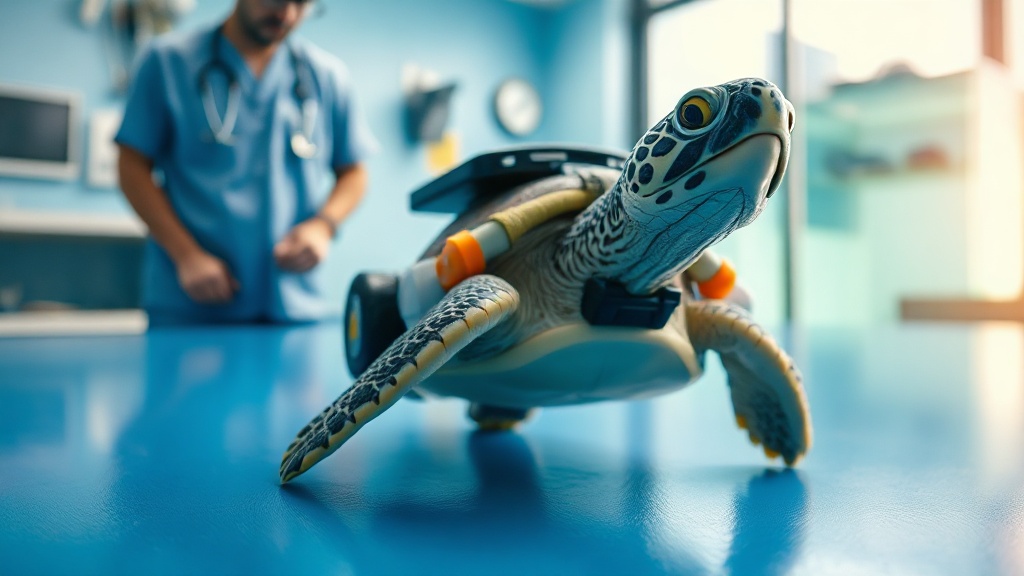

Custom 3D-Printed Support Solution for an Injured Turtle at Mississippi Aquarium
A 3D-printed support solution that helped an injured turtle move more comfortably again shows how personalized manufacturing can deliver remarkably practical results. A box turtle at Mississippi Aquarium that had lost the use of its hind legs was fitted with custom devices — proof that 3D printing can be used effectively not only in human-focused applications but also in animal rehabilitation and care. This approach is especially valuable in situations that demand rapid prototyping and size-specific revisions.
Why does 3D printing stand out in this type of rehabilitation?
The biggest challenge with animal-specific support equipment is that standard sizing rarely works. An animal’s anatomy, weight distribution, movement patterns, and sensitive areas are unique. Finding an off-the-shelf solution can be difficult, and even when one is found it may not fit perfectly. 3D printing offers the advantage of fast iteration, size-specific adjustments, and reprinting as many times as needed.
What stands out in this story is not producing a perfect part on the first attempt, but reaching the right geometry through several iterations. This is precisely where the power of 3D printing reveals itself: the ability to experiment.
Why is rapid prototyping critical?
In rehabilitation solutions, comfort of use cannot be judged simply by whether the part can be attached. You need to observe how the animal responds to the device, how it maintains balance while moving, and where it places its weight. For this reason, the path from prototype to final product is often gradual. 3D printing accelerates this cycle.
- A first trial sized to measurement can be prepared quickly.
- Ill-fitting areas can be remodeled and reprinted.
- A better balance between lightness and durability can be achieved.
- The care team can rapidly incorporate field feedback into the design.
What is the lesson here for industrial users?
This story is not just an emotionally moving success story; it is also a clear example of product-development logic. Whether the end user is human or animal, iterative design tends to be more efficient than standard tooling for parts that come into contact with a body or a specific use context. The same principle applies in industry for fixtures, ergonomic aids, protective covers, and custom assembly helpers. In Ucuz3D’s automation- and robotics-focused production approach, the usage context of a part matters just as much as its design.
In short, what is described here is not merely helping a turtle — it is tangible proof of how powerful a feedback-driven, personalized product development mindset can be.
The real power of custom design
One of 3D printing’s greatest advantages is that it does not impose a single correct solution. Parts that are adapted to the need, updated with feedback, and can be reproduced make many problems that are difficult to solve with traditional methods accessible. The Mississippi Aquarium example illustrates this very clearly: sometimes a small but well-designed part can make a tremendous difference in quality of life.
Examples like this confirm a reality we often see in industry as well: the first prototype is rarely the final solution. What creates value is the ability to gather rapid feedback and update the design just as quickly. That cycle speed is precisely what makes 3D printing powerful.
This shared logic — spanning from animal care to industrial fixtures — clearly shows why parts tailored to a person or a specific use case can be solved more efficiently than through a classic stock approach.
If you also want to produce custom-use fixtures, support parts, or functional prototypes suited to your specific operating conditions, you can explore our production approach and pricing philosophy, or share your project details with us directly.



 Türkçe
 العربية
 Русский
 فارسی
فارسی Deutsch