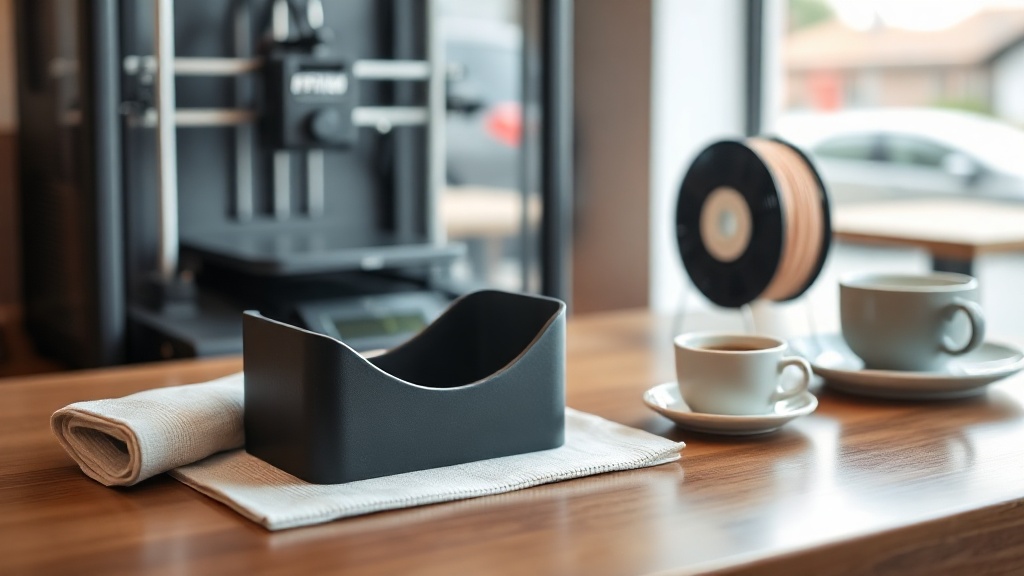

From Idea to Prototype: The Story of a Custom Napkin Holder for a Coffee Shop
Last month, the owner of a small coffee shop sent us a message saying he was fed up with napkins scattering all over his counter. What he was looking for simply didn’t exist on store shelves: a napkin holder that would fit on a narrow counter, match the shop’s wood-and-green aesthetic, and carry his small logo. This is exactly where prototype 3D printing came in — because it is the fastest way to turn a single idea into a tangible object without the cost of tooling.
Turning an Idea into a Measurable Design
We started by visiting the shop to measure the counter and the napkins being used. A good design begins with accurate measurements, not just a beautiful sketch. Once we had the napkin width, how many napkins the stack would hold, and the available space on the counter, the first draft took shape.
The key considerations in the first draft were:
- An angle that holds napkins without compressing them, yet keeps them from blowing away in the wind
- A front opening suitable for pulling out a single napkin with one hand
- A flat surface on which the logo could be read as an embossed element
- A form that would not stain on a wet counter and would be easy to wipe clean
Why Prototype First?
The first print is never the final product. In the first attempt, the napkin slot was too narrow and the stack was forced in. In the second version, we widened the opening by a few millimetres and increased the base weight. In the third attempt, we fine-tuned the depth of the logo. These three quick rounds compressed what would have been weeks of costly learning in mould-based production into just a few days.
During the prototyping phase, it generally makes sense to start with an easy-to-process and economical material like PLA. Once the form was finalised, we switched to a material like PETG that is more durable and less affected by moisture — appropriate for a café environment. This kept trial costs low while ensuring the final product was fit for real-world use.
A Few Practical Lessons from the Process
For custom business parts like these, the biggest time-saver is clear measurements and realistic expectations from the very beginning. It is not enough for an object to look good on screen; it must perform its function when you pick it up. A physical prototype instantly reveals ergonomic details you would never notice on a screen.
If you have a part in mind that you cannot find as an off-the-shelf product, even a rough sketch or a set of measurements can be enough to get started. If you would like to see an estimated cost upfront, you can check our production pricing page, and then share your idea with us via the quick quote form.
Jot down that small product idea of yours; the best moment to start a conversation is the moment you draw your first sketch.


 Türkçe
 العربية
 Русский
 فارسی
فارسی Deutsch