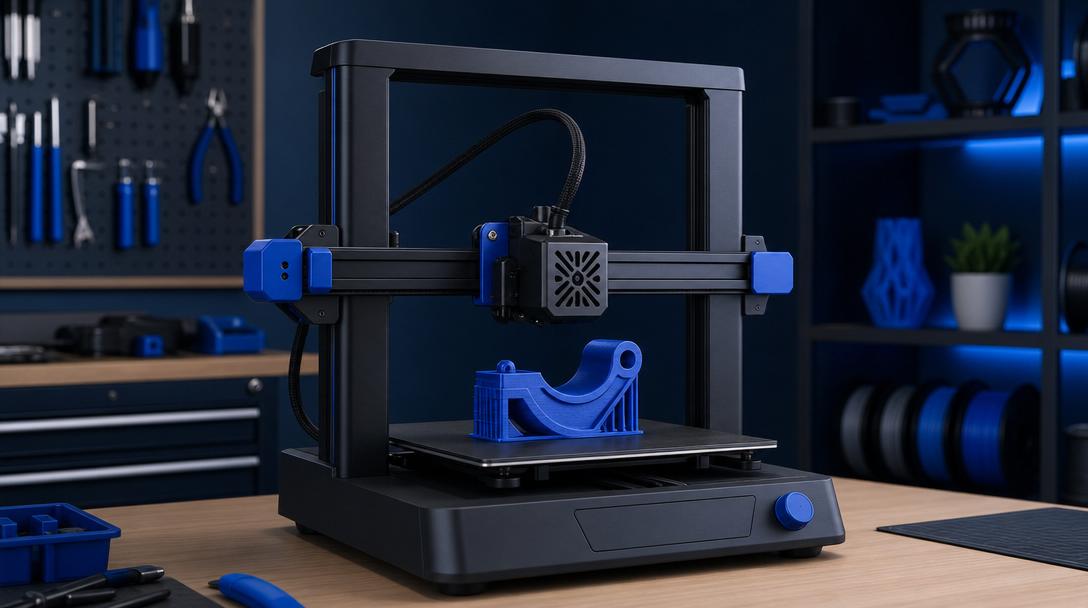

FDM Prototyping Is Now Within Every Budget: Can Desktop Printers Produce Industrial Parts?
Until just a few years ago, the phrase “prototype 3D printing” brought to mind high-budget industrial machines and expensive consumables. Today, however, desktop FDM printers in the $200-$300 range can produce functional prototypes using standard filaments. So can FDM prototyping, now this accessible, truly reach industrial quality? Let’s take a look together at the latest developments, when home printing is enough, and when professional service needs to step in.
Where Is the Line Between Desktop FDM and an Industrial Prototype?
Over the past two years, competition among manufacturers like Bambu Lab, Creality and Elegoo has dramatically raised the speed and precision of desktop FDM printers. Prototypes can now be printed at 0.1 mm layer heights and speeds of 300 mm/s, even with materials like ABS and PETG without an enclosed chamber. Thanks to multi-color printing systems, visual details such as color separation and logos can even be produced on prototypes in a single pass. But does this completely eliminate the need for professional prototype 3D printing services? The short answer: no. The long answer depends on material variety, tolerance requirements and production scale. While desktop printers are an excellent tool for rapid idea validation, not every type of prototype is produced to the same quality standard.
Which Prototypes Are Suitable for Desktop FDM, and Which Are Not?
Not every prototype requires the same quality standard. The list below summarizes which types of parts should be produced with desktop printers and which call for professional service:
- Form and fit prototypes: Ideal for testing a product’s physical dimensions and assembly fit. PLA or PETG is sufficient, and they can be printed easily on desktop printers.
- Functional test parts: Mechanically loaded parts such as gears, hinges, clips or bearings require engineering materials (nylon, polycarbonate, carbon-fiber-reinforced filament). Most of these materials demand a hardened nozzle and an enclosed chamber.
- Visual presentation models: When surface quality is a priority, fine layers (0.08-0.12 mm) and post-processing (sanding, primer, paint) are needed. While possible on desktop printers, the labor time is high.
- Small-batch production (10-50 units): These can be printed on desktop printers, but the time per unit, scrap rate and quality consistency are more variable than with professional service.
Material Selection Plays a Key Role in Prototype Success
The biggest obstacle to producing industrial prototypes on desktop printers is material variety and printing conditions. While standard PLA and PETG are sufficient for many prototypes, for parts requiring high-temperature, impact or chemical resistance, 3D printing with engineering materials becomes unavoidable. Automotive prototypes favor polycarbonate (PC) or carbon-fiber-reinforced nylon, food-industry prototypes lean on PETG, and the defense industry highlights flame-retardant materials. Most of these materials require an enclosed chamber, a hotend capable of 300 °C and above, and a hardened steel nozzle to print on desktop machines. Moreover, moisture-sensitive materials such as nylon and PC must be dried before printing.
Cost Comparison: Home Printing or Professional Service?
When calculating the cost of a prototype, looking only at the filament price is misleading. Printer depreciation, electricity consumption, scrap rate, failed prints, labor and time factors must also be taken into account. Especially for one-off prototypes, taking advantage of a professional service is often faster and more economical than investing in your own printer and wrestling with settings. If you’re wondering how much your project will cost, you can upload your STL file with our instant price calculator and get a quote in seconds. Thanks to our transparent per-gram pricing, you can see your budget clearly in advance.
If you’d like to learn more about FDM prototyping and understand in detail which material suits which prototype type, take a look at our guide on the advantages of 3D printing in prototyping. In this guide you’ll find comprehensive information ranging from material selection to design tips.
In conclusion, desktop FDM printers offer great convenience, especially during rapid idea validation and form-testing stages. However, for functional, durable prototypes with high dimensional precision, professional FDM service remains the most reliable route. To find the solution best suited to your project’s requirements, choose the right material and obtain a quality prototype, get in touch with us and we’ll assess your needs in detail.


 Türkçe
 العربية
 Русский
 فارسی
فارسی Deutsch