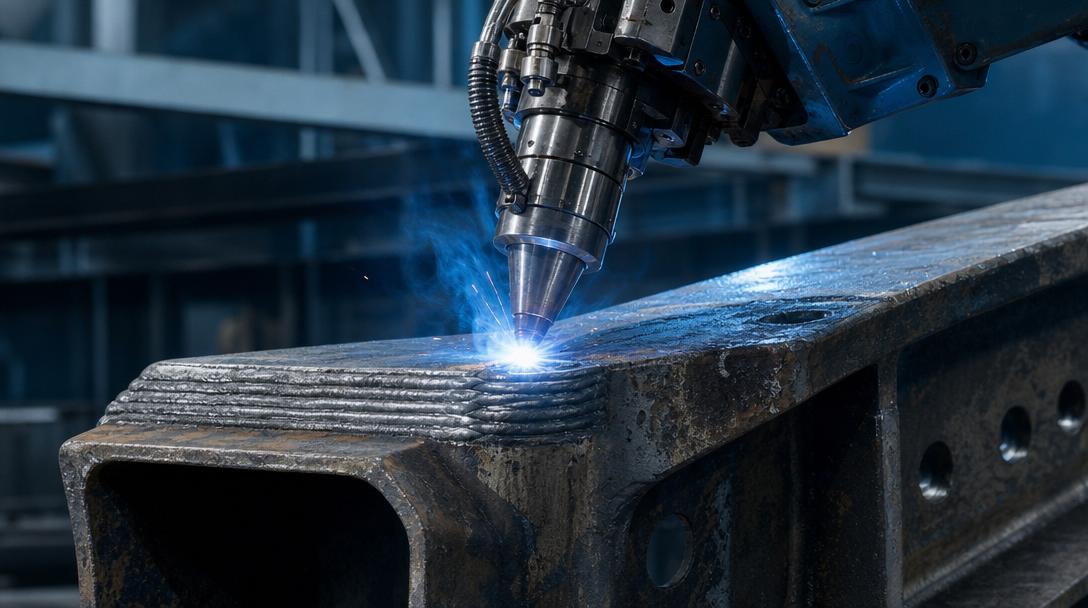

Empa Explores a New Method for Repairing Steel Infrastructure with WAAM
The Swiss Federal Laboratories for Materials Science and Technology (Empa) is exploring the use of WAAM (Wire Arc Additive Manufacturing) technology to repair steel infrastructure. The research focuses on applying patches to cracked and damaged areas in bridges and other critical steel structures using additive manufacturing based on wire arc welding. Developed as an alternative to conventional repair methods, this approach promises advantages in both cost and time.
Why Is Repair So Important in Steel Structures?
From bridges to skyscraper frames, steel forms the backbone of modern infrastructure. Despite their high strength-to-weight ratio, steel elements are exposed over time to fatigue cracks, corrosion, and impact damage. Existing repair methods usually require cutting out the damaged area and welding in a new part; this process is both expensive and time-consuming.
WAAM-based repair, on the other hand, works by depositing metal layer by layer directly onto the damaged area. This way:
- Material is added only where it is needed, reducing waste.
- The greater part of the existing structure is preserved.
- The work can be carried out on-site with portable systems.
Empa’s Approach
Empa researchers are optimizing WAAM process parameters specifically for steel repair. The work covers critical factors such as layer quality, heat input, and residual stress management across different types of steel. The goal is to ensure that the WAAM patch applied to the damaged area reaches mechanical strength equal to or greater than that of the base structure.
Focusing in particular on fatigue cracks in bridges, the team has observed in lab-scale tests that patches applied with WAAM stop crack propagation and restore structural integrity.
The Future of WAAM Technology in Infrastructure
WAAM is rapidly gaining ground, especially in the production and repair of large-scale metal parts. Although its use in infrastructure repair is still at the research stage, early findings show that this technology could significantly reduce maintenance costs. As metal additive manufacturing and repair technologies advance, methods like WAAM are expected to become standard for extending the lifespan of structures such as bridges, viaducts, and industrial facilities.
While Ucuz3D offers FDM-focused 3D printing services, we closely follow how these industrial-scale developments are transforming the entire additive manufacturing ecosystem. If your project needs a part that can be made with FDM, you can see the cost with our instant price calculation tool and place an order online. For more detailed information on the basic principles of additive manufacturing, take a look at our 3D Printing Cost Guide.




 Türkçe
 العربية
 Русский
 فارسی
فارسی Deutsch