
Braille 3D Printing: A Guide to Producing Tactile Maps and Labels for the Visually Impaired
Whether a label is useful or not is decided by a fingertip; an incorrectly spaced or flattened Braille dot becomes unreadable for a visually impaired user. Braille 3D printing, when done to the correct dimensions, is one of the most flexible ways to produce accessible signage, tactile maps, and product labels — but here, conforming to standards comes before aesthetics. In this post we share the technical foundations of producing readable tactile content.
Braille Dimensions Are Non-Negotiable
Braille dots must be sized according to specific standards; a design that looks beautiful to the eye can be illegible to the touch. The generally accepted reference values are as follows:
- Dot diameter: approximately 1.4–1.6 mm at the base.
- Dot height: approximately 0.6–0.8 mm; dots that are too tall cause discomfort, while dots that are too flat cannot be felt.
- Center-to-center spacing within a cell: approximately 2.5 mm.
- Spacing between cells: approximately 6 mm.
Modeling the dots with a gently rounded top (dome shape) rather than a sphere or hemisphere gives a more comfortable feel under the fingertip and avoids sharp edges.
Print Settings and Surface Quality
At such small scales, layer height is decisive. Printing with thin layers of around 0.1–0.12 mm makes the surface of the dots smooth and readable. Position the model with its flat side facing the print bed so the dots build upward from the base; this eliminates the need for support material and results in clean dot tips.
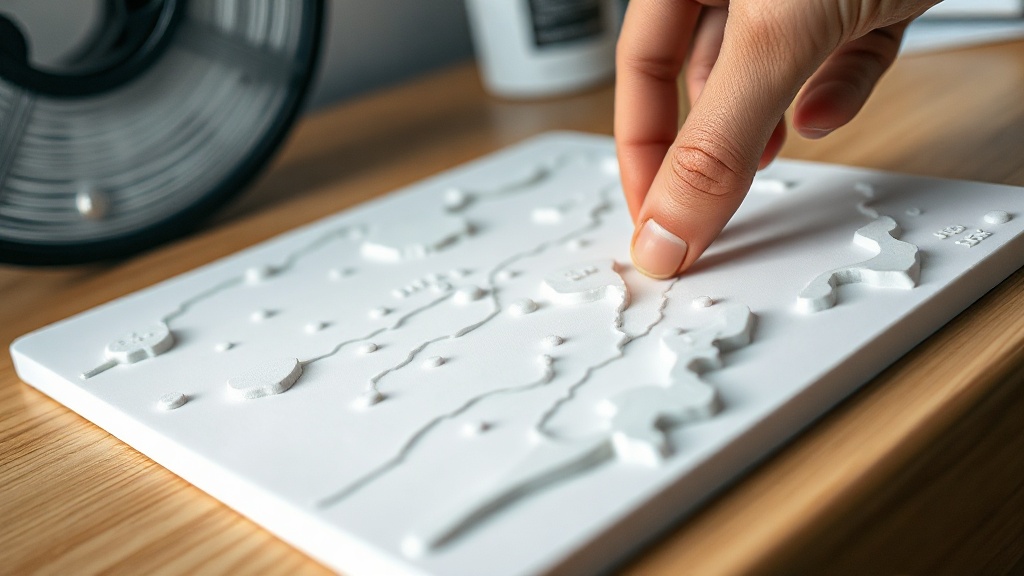
Tactile differentiation on tactile maps
For complex work such as maps, it is necessary to distinguish different paths, boundaries, and areas by touch. Use differences in height and varied texture patterns for this — for example, streets can be a straight raised line, while green areas can have a dotted texture. High-contrast colors can also be added for low-vision users who have color blindness.
As a material, matte-finish PLA is a good starting point because it does not reflect light and holds fine detail well. If you would like to print a prototype for your accessibility project, contact us with your dimensions and quantity; we will prepare a quick quote along with a suitable material recommendation.
Are you preparing an accessible space or publication? Let us print a sample cell and evaluate the tactile quality together.



 Türkçe
 العربية
 Русский
 فارسی
فارسی Deutsch