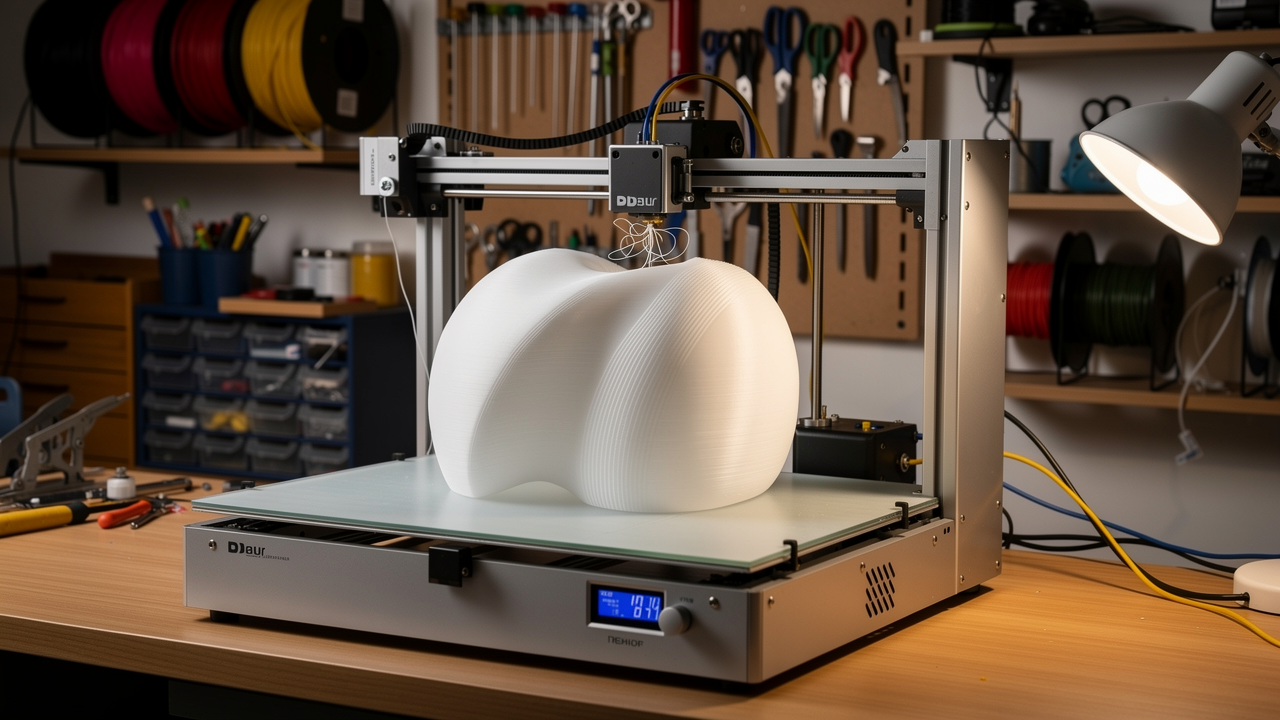

Bambu Lab A2L makes large-format FDM printing more accessible
On the large-format FDM printing front, the most notable recent development was the A2L model that Bambu Lab announced on June 1, 2026. The news shows that desktop systems, which make it easier to produce larger single-piece PLA and PETG parts, are now starting to reach a much wider audience.
According to information published in TCT Magazine, the A2L positions itself for large parts, decorative products, fixtures and prototypes thanks to a 330 × 320 × 325 mm build volume and a print speed reaching up to 500 mm/s. The key point, however, is not just speed; being able to print a larger model in a single job reduces the need for multi-part production and post-gluing, which improves both the workflow and surface continuity.
Why is the A2L seen as important?
In recent years, speed and ease of use have stood out in the desktop FDM ecosystem; this news shows that, on top of those, the move of build volume into an accessible price segment will now be a talking point. Large-format systems can offer a serious advantage in areas such as cosplay, scale models, workshop fixtures, prototype enclosures, assembly aids and single-piece functional parts.
- The ability to produce larger parts without splitting them
- The potential to reduce extra gluing and alignment steps
- A wide range of use cases with common filaments such as PLA and PETG
- The option to set up more efficient part placement in a print-farm approach
The report also mentions a closed-loop servo motor, vibration compensation, dampers that reduce resonance, and detection systems that monitor risks such as clogging and filament tangling. Features like these are important for catching errors early, especially in long, large prints. Because as the build volume grows, the material and time cost of a small extrusion problem grows with it.
What does this development mean in practice for ucuz3D?
Every new printer launch does not directly mean “we use the same machine”; however, the trend the news points to shows that demand for larger and cleaner single-piece outputs in FDM production is increasing. Choosing the right material remains critical, especially for prototypes, enclosures, workshop fixtures and functional plastic parts. So those who want to compare material options can review our 17 material options; and for more durable, functional use cases, it makes more sense to look at printing solutions with engineering materials.
Success in large-format FDM printing does not depend on the printer alone. If the part’s print orientation, support requirements, wall thickness and assembly points are not thought through properly, the large-volume advantage can go to waste. For this reason, it is important to consider basic principles such as design for printability and the 45-degree rule during the design stage.
What does it tell us about the market?
The A2L news shows that two trends are converging in the FDM world: larger volume and a lower barrier to use. This combination matters not only for hobbyists, but also for low-volume product development, quick test parts, trade-show prototypes and producing in-house workshop aids. Being able to print larger in a single piece reduces assembly risk in some projects while also shortening the delivery process.
If you have a large part, a prototype enclosure or a functional FDM production need on your hands, you can start by uploading your file and using the instant price calculation step. This way you can see the impact of build volume, material and part geometry on cost much more clearly.


 Türkçe
 العربية
 Русский
 فارسی
فارسی Deutsch