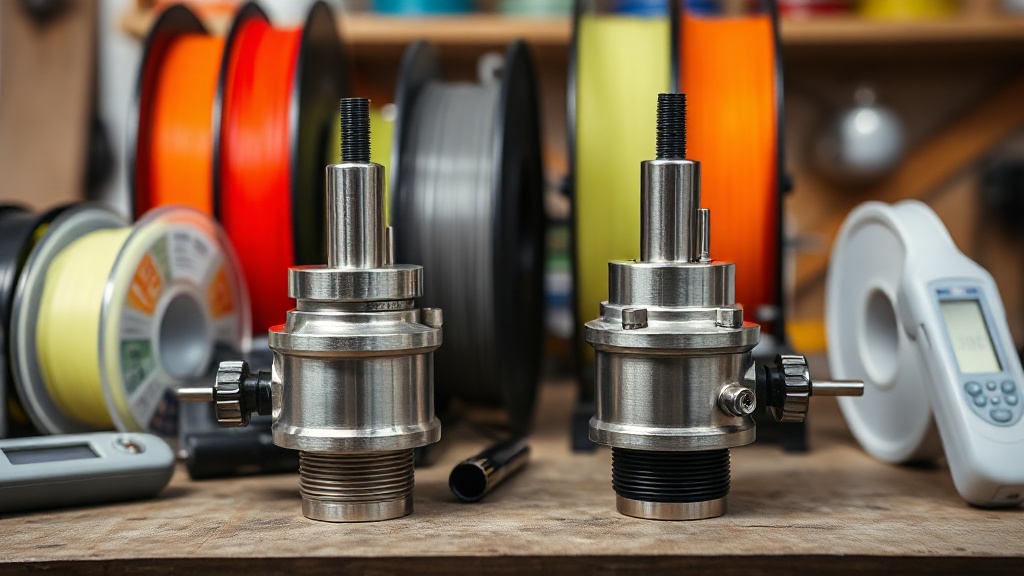

All-Metal Hotend vs PTFE-Lined? The Right Choice for High-Temperature Prints
Anyone switching to a new material eventually asks the same question: can my current hotend handle it? The decision usually comes down to an all metal hotend versus a PTFE-lined hotend, and that choice directly determines which materials you can safely print. In this article we break down the differences between the two designs and explain when each one makes sense.
The fundamental difference between the two designs
In PTFE-lined hotends, the filament travels inside a Teflon (PTFE) tube that extends almost all the way to the nozzle. This tube reduces friction and ensures smooth filament flow. However, PTFE begins to degrade above roughly 240-250 degrees and can release harmful gases. In an all-metal hotend, the PTFE tube never enters the hot zone; the melt zone is made entirely of metal, which allows you to reach much higher temperatures.
Which one is right for you?
When is a PTFE-lined hotend sufficient?
- For printing primarily PLA, PETG, and TPU at standard temperatures
- When a printing temperature range that stays below 250 degrees is enough
- When lower cost and reduced heat-creep risk with PLA are priorities
- When ease of maintenance and assembly matters most
When is an all-metal hotend necessary?
- For high-temperature materials such as ABS, ASA, nylon, and polycarbonate
- For carbon- or glass-fiber-reinforced filaments (paired with an abrasion-resistant nozzle)
- When printing above 250 degrees for extended periods
- For manufacturers working with a wide range of materials
The trade-off to keep in mind
An all-metal hotend is not always superior. Because the lubricity provided by PTFE is gone, it can be more prone to heat creep and clogging, especially with low-temperature materials like PLA. This is why cooling performance and correct retraction settings are far more critical in all-metal systems. In other words, there is no universal answer to which hotend is best — the right answer depends on the material you are printing.
In our workshop we produce each of 17 different materials with hardware matched to its own temperature profile, giving you full flexibility in material selection. If you are unsure which material suits your project, you can browse the options on our production pricing page and reach out to us whenever you have questions.


 Türkçe
 العربية
 Русский
 فارسی
فارسی Deutsch