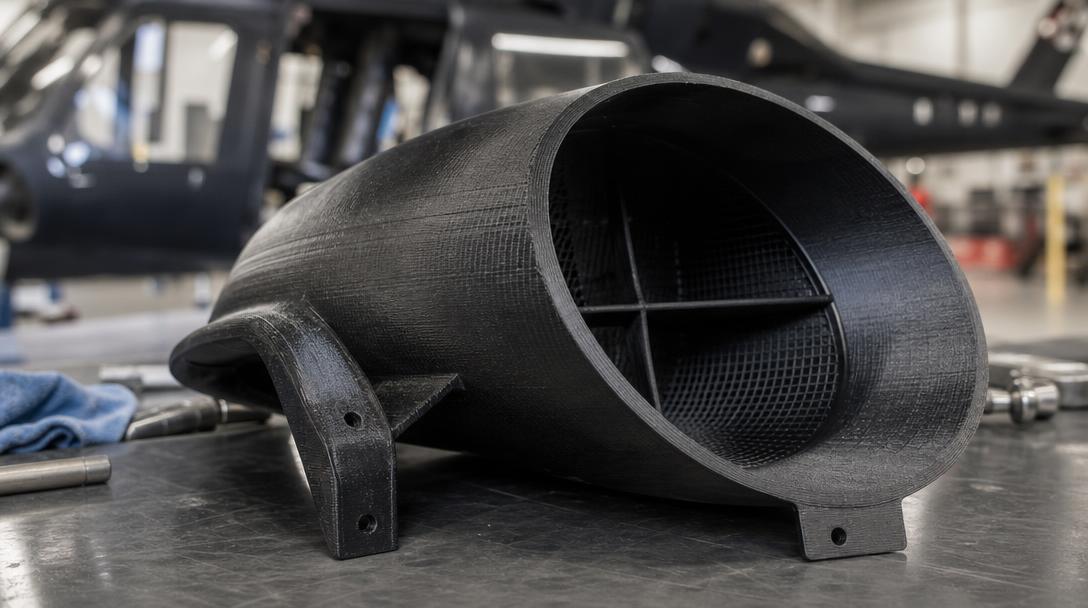
3D-Printed Helicopter Spare Part: Plane Support Gets CASA Approval for Bell 214B Air Duct
3D printing for helicopter spare parts offers a new example of how hard-to-find plastic components can be used in maintenance. Australian aviation maintenance company Plane Support has received approval from the Civil Aviation Safety Authority of Australia (CASA) to produce an air duct component used in the Bell 214B helicopter through additive manufacturing. The news appeared in aviation and additive manufacturing publications on 12–13 October 2026.
Why the approval matters: it is not enough to print the part; compliance must be demonstrated
In aviation, having a digital model of a part or being able to manufacture it is not, by itself, enough to put it into service. The part must perform its function safely, its production and inspection steps must be traceable, and the relevant regulatory requirements must be met. That is why CASA approval is central to this case: the use of 3D printing to produce a maintenance part is subject to an authorized oversight process.
The component in question is an air duct for the 214B helicopter. Air ducts of this kind direct airflow to a specific location and must fit the surrounding system. Spare parts can be difficult to obtain for older or less common aircraft models, and waiting for a part through the traditional supply chain can also affect maintenance schedules. When the design and approval requirements are met, additive manufacturing can offer an alternative production route for low-volume parts or components that are no longer readily available.
Not an automatic solution for every spare part
This development should not be interpreted as meaning that “aircraft and helicopter parts can now be 3D-printed anywhere.” The choice of material and production method depends on the part’s operating temperature, load, vibration, environmental conditions, and certification scope. Design data must also be validated for each part, production parameters controlled, and quality records maintained. The approval applies to a specific application; the same outcome cannot be assumed for a different part or use.
The broader lesson, then, is less that 3D printing eliminates the supply process altogether and more that it offers a new production option for carefully selected parts. For low-volume components with specialized geometry that are difficult to source, redesigning the part and validating the production process should be considered together. In aviation, these steps are carried out within a regulatory framework; in everyday industrial applications, too, the part’s function and risk level should guide material selection.
Where can a similar approach work in FDM services?
The aviation approval in this case cannot be generalized to every part printed with FDM. However, the maintenance and spare-parts aspect points to a broader approach to manufacturing. Low-volume parts such as a broken housing, a plastic cover that is no longer manufactured, a custom cable guide, or a workshop-specific fixture may be suitable for FDM if the conditions of use allow it. It is important to establish in advance whether the part is safety-critical, whether it operates under heat or load, what dimensional tolerances are needed, and which material properties are required.
You can review the options available through our 3D printing service to assess your file’s suitability for production and choose a material; the per-gram pricing approach is outlined on the affordable 3D printing prices page. Uploading your model to get an online 3D printing price estimate can also help with an initial assessment. For guidance on taking measurements and creating a model for reproducing a spare part, see our guide to 3D scanning and reverse engineering.
In short, the Plane Support case shows that the value of 3D printing in aviation lies not only in production speed, but also in a controlled spare-parts process defined by regulatory approval. Printing cannot be considered a reliable maintenance solution unless suitable part selection, a validated design, and traceable production come together.


 Türkçe
 العربية
 Русский
 فارسی
فارسی Deutsch