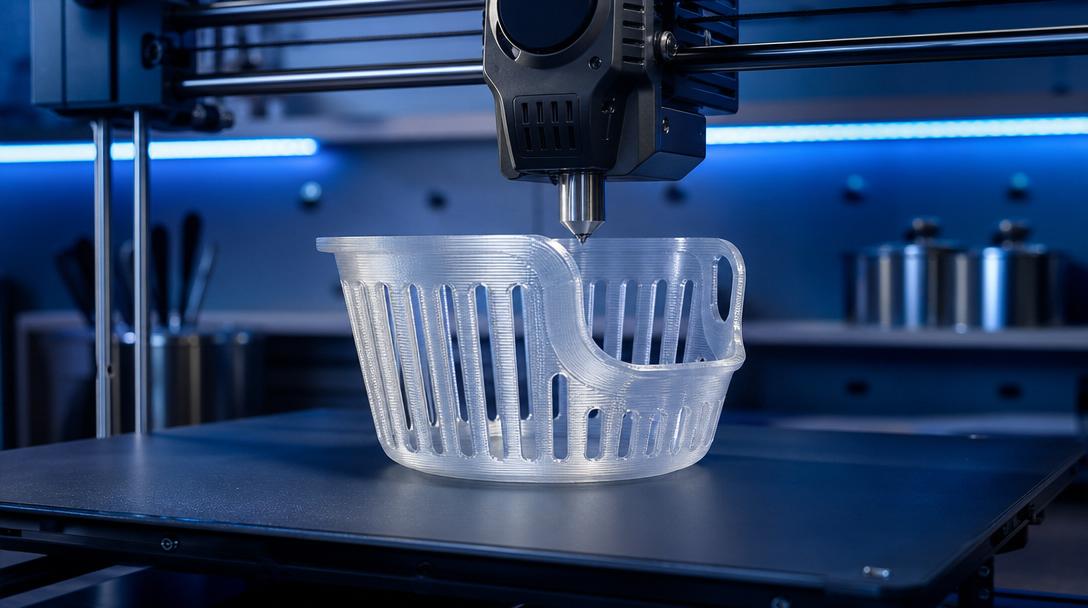

Which Filament Is Safe for Parts That Come into Contact with Food?
Parts that come into contact with food are a case where saying “this filament is safe” on its own is often misleading. In FDM printing, not only the chemical structure of the material matters, but also the nozzle type, the roughness of the printed surface, the dyes and additives used, and even which filaments the printer has previously been used with. That is why, when deciding on a part to be used in the kitchen, you need to look not only at whether it should be PLA or PETG, but also at how the part will be used.
Why is it not enough to look only at the material when choosing filament?
Even if a filament spool is labeled “food safe,” that does not automatically mean the final part is suitable for food contact. In FDM printing, layer lines can create microscopic gaps, and these gaps can trap moisture and bacteria. In addition, using a brass nozzle, residue left from previous prints, or color pigments can also increase the risk. For this reason, in direct and repeated food-contact applications—especially on the professional production side—it is safer to make a process-based evaluation rather than relying only on hobby-level knowledge.
At Ucuz3D, when planning a 3D printing service, it is important to clarify this distinction from the start: parts such as measuring cups, funnels, accessories, holders, or fixtures are not evaluated in the same category as products that will be used as direct food-contact surfaces.
Which options make the most sense in the FDM world?
From a general-use perspective, natural-colored, additive-free PETG from a reliable manufacturer and some types of PLA are the most commonly discussed options. PLA is often assumed to be automatically safe because it comes from plant-based raw materials; however, additives, dyes, and the post-print surface condition can change that. PETG, on the other hand, generally performs more consistently in the presence of moisture and liquid contact, which is why many users see it as a more sensible starting point for kitchen accessories. If you would like a more technical framework for PETG, the guide PETG: The Material That Combines the Best Aspects of PLA and ABS is also a good reference.
By contrast, ABS, ASA, nylon, or carbon-fiber-reinforced materials may offer certain industrial advantages, but they require extra caution when making decisions for food contact. High performance does not automatically make them more suitable. If your goal is hygiene as much as durability, you should first define the part’s usage scenario and then choose the material. For functional and technical materials, you can also evaluate the options for printing with engineering materials.
What conditions are needed for a safer result?
For an FDM part that approaches food-contact use, not only the filament but also production discipline is decisive. The following conditions become especially important for a part that will be washed frequently, remain damp, or come into direct contact with edible products:
- Choosing natural or low-additive filament: Colored, glitter-filled, or spools with unknown additives create more question marks.
- Stainless steel nozzle: Choosing stainless steel instead of a brass nozzle reduces contact risk.
- Clean and separated production line: If different experimental materials have been printed on the same printer, there may be a risk of cross-contamination.
- Aiming for a smoother surface: The fewer the layer gaps, the easier it is to clean.
- Clearly defining the usage limit: One-time contact with dry food is not the same as continuous, hot, and wet use.
For this reason, if you are considering a part such as a cookie cutter, coffee funnel, or packaging aid, it is helpful to specify the intended use from the design stage onward. To see the cost side in advance, you can check the affordable 3D printing prices page, and if your model is ready, you can get an instant quote.
Final decision: Which filament is safer?
The short answer is this: in FDM printing, no filament should be considered universally safe regardless of production conditions. Still, in low-risk and indirect-contact scenarios, natural-colored PETG from a reliable source is one of the most balanced options for most users, while PLA should be considered more for cold, short-term, and low mechanical-load applications. If hot food, long-term contact, intensive washing, or commercial use is involved, it is not correct to decide based only on the filament name.
If you would like to clarify the most sensible FDM approach for parts that come into contact with food in your project, share your usage scenario and model. That way, you can plan the material choice, surface expectations, and production method more accurately according to the part’s real needs.


 Türkçe
 العربية
 Русский
 فارسی
فارسی Deutsch