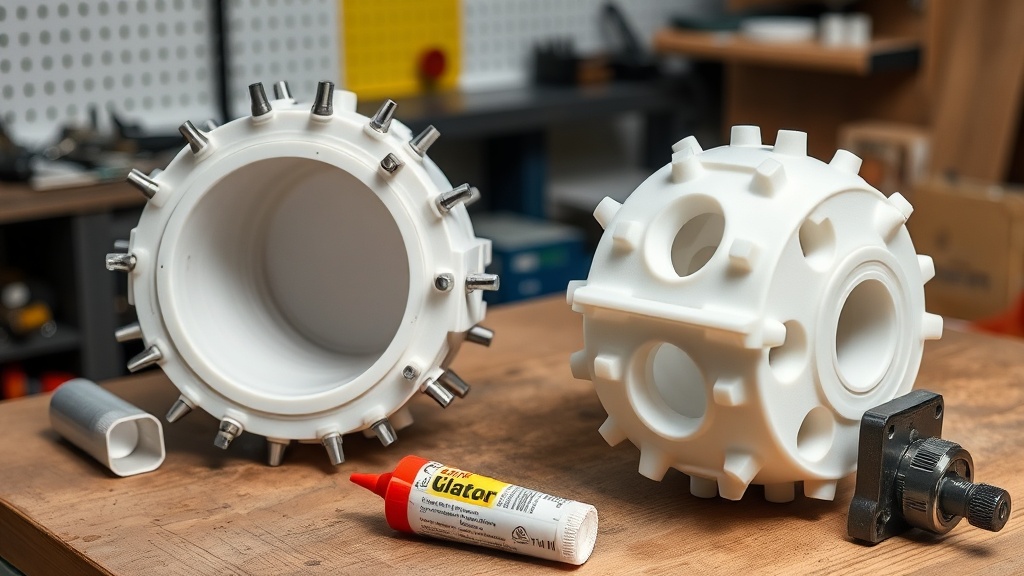

Part Splitting and Joining Guide: Dowels, Locks, and Gluing Surfaces
When modeling a scale ship, a helmet shell, or a large figurine, you’ll often hit the same wall: the model doesn’t fit on the print bed. This is exactly where a part splitting and joining strategy comes in. Instead of cutting the model arbitrarily, if you design the split lines and joint surfaces from the start, printing becomes easier and you end up with a nearly seamless surface after assembly.
Where Should the Split Line Run?
The first decision is the location of the cutting plane. The general rule is to keep the line along a natural edge or on the back side rather than on a visible surface. A flat cut enlarges the bonding surface area and increases the gluing zone. Also make sure each part can be printed on its own base with little or no support; the split point is also an opportunity to improve the print orientation.
Dowels and Locks for Alignment
Simply pressing two parts together and gluing them is not enough on its own – sliding and angular errors will occur. To mechanically guarantee alignment you can use the following:
- Cylindrical dowel (pin): Add a protrusion on one part and a socket on the other. Design the socket roughly 0.2-0.3 mm larger than the pin so tolerances don’t cause problems.
- Keyway: An asymmetric protrusion ensures the parts can only join in the correct orientation, making reverse assembly impossible.
- Snap-fit clip: For parts that need to be removable, you can design a flexible clip instead of gluing.
Printing the dowels as separate cylinders and fitting them into two sockets is generally more flexible for tolerance adjustment than integrating them directly into the model.
Strengthening the Gluing Surface
Contact area matters for a strong bond. A stepped (lap joint) or diagonal surface instead of a flat cut both increases the adhesive area and improves shear resistance under load. Cyanoacrylate or two-part epoxy works well for PLA and PETG; for ABS parts, acetone-based welding creates very strong bonds. Sanding and degreasing the surfaces before gluing extends the life of the joint.
Material choice also affects the splitting decision: TPU may be more sensible for a flexible joint, while glass-fiber-reinforced filament is better for a load-bearing connection. If you’re unsure which material suits your part, you can share your file through our quick quote page and get guidance.
When you send a file with correctly designed split lines and dowel sockets, your large project transforms into a clean result that looks like a single piece. Don’t hesitate to consult us if you’re unsure about your design.



 Türkçe
 العربية
 Русский
 فارسی
فارسی Deutsch