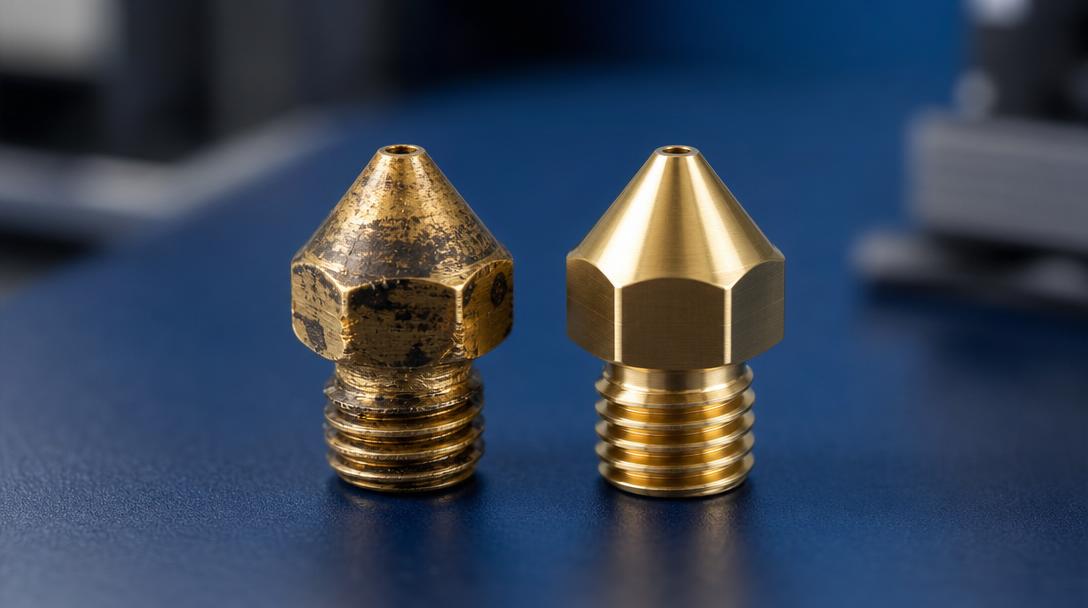

How to Know When It’s Time to Change Your Nozzle? 7 Signs of Wear and the Measurement Method
The nozzle is one of the most critical yet most frequently neglected parts of 3D printers. A worn nozzle can be the source of many problems, from layer shifting and surface roughness to flow inconsistency and filament jams. So how can you tell when it’s time to change the nozzle? In this article, we explain step by step the 7 most obvious signs of wear and the practical method to determine your nozzle’s lifespan correctly.
7 Signs of a Worn Nozzle
Nozzle wear usually doesn’t happen overnight — it creeps up gradually over time. If you notice one or more of the following symptoms, it may be time for a check-up:
- Sudden drop in surface quality: If parts that used to print smoothly are now coming out rough and dull, the nozzle orifice may be deformed.
- Irregular filament flow: If extrusion is inconsistent, with some layers coming out thin and others thick, the nozzle’s internal diameter is worn.
- Persistent stringing and oozing: A sudden stringing problem that won’t go away with settings adjustments can be caused by an enlarged nozzle opening.
- Weakened layer adhesion: If parts printed with the same settings are no longer as strong as before, the nozzle’s internal surface has deteriorated.
- Dimensional deviations: If printed holes turn out smaller or larger than intended, the nozzle diameter is no longer standard.
- Filament buildup around the nozzle: A worn opening causes filament to spill outside the nozzle; you’ll see stuck plastic residue on the nozzle during printing.
- Visible nozzle damage: The nozzle opening becoming rounded, burred, or pitted can be seen with the naked eye or a magnifying glass.
The Most Practical Way to Measure Nozzle Wear
If visual inspection isn’t enough, the most reliable method is to measure with a caliper. A new nozzle’s outlet hole is very close to its rated value (e.g. 0.40 mm). In a worn nozzle, this value can go up to 0.45 or even 0.50 mm. To measure, remove and clean the nozzle, then measure the outlet opening with a caliper; if there’s more than 10-15% deviation from the nominal value, it’s time for a replacement.
Another practical test is to print a 20 mm calibration cube and measure the wall thickness. If the wall thickness is significantly greater than expected even though the flow rate in the slicer is correct, the nozzle may have expanded. This test is especially important for mechanical parts that require precise tolerances — a gearbox or bearing housing printed with the wrong nozzle diameter can cause problems during assembly.
Another way to catch nozzle wear early is to perform a quick visual and tactile check before printing. Heat up the nozzle and gently touch it to a piece of paper to check the shape of the outlet. A non-circular, oval impression indicates the nozzle opening is deformed. Once you develop a habit of regular checks, you’ll also stay on top of basic nozzle maintenance with the steps in our how to clean a clogged nozzle guide.
Nozzle Selection and Lifespan: The Right Material, The Right Decision
Nozzle lifespan largely depends on the type of filament you use. With non-abrasive materials like standard PLA and PETG, brass nozzles work flawlessly for months, but with carbon fiber reinforced or metallic-looking filaments, this period can drop to just a few weeks. That’s why you should choose hardened steel or tungsten carbide nozzles for abrasive filaments. At Ucuz3D, we use the right equipment for every project with our 17 material options, producing your parts to professional standards.
When you add regular nozzle inspection to your printer maintenance routine, your print quality stays consistent, material waste is reduced, and your parts come out within predictable tolerances. If you don’t have time to do your own nozzle checks or you’re looking for a professional-quality 3d printing service, send us your design. You can find out the cost in seconds from our calculate your instant price page and order your print online with the advantage of transparent per-gram pricing.



 Türkçe
 العربية
 Русский
 فارسی
فارسی Deutsch