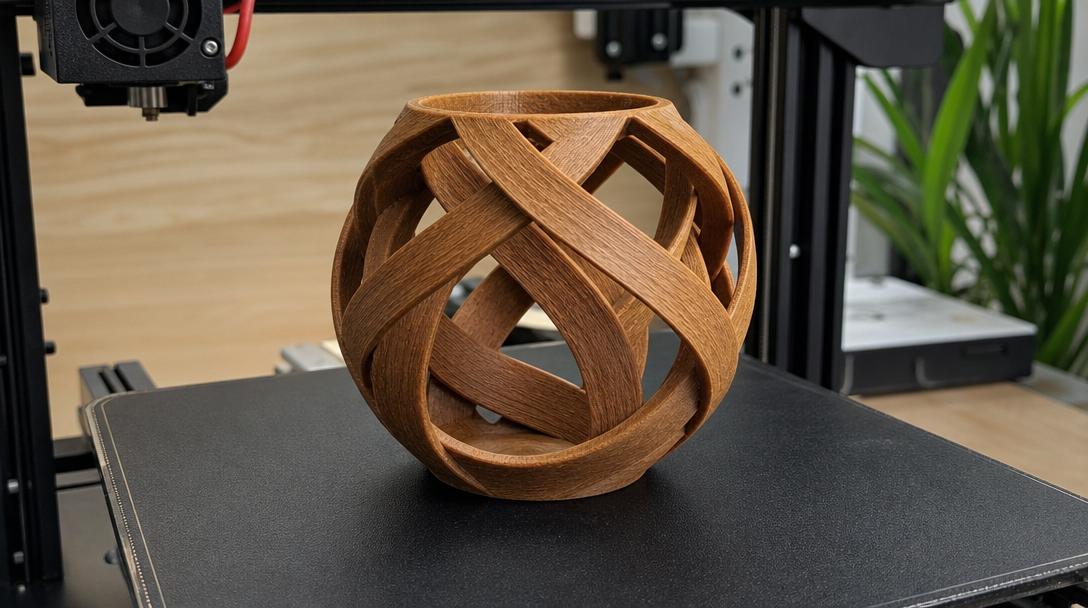

How to Achieve a Real Wood Look With Wood-Filled Filament
Is it possible to make wood-look objects with 3D printing? Yes, thanks to wood-filled filaments. Produced by mixing real wood dust (at a ratio of 20-40%) into PLA, these special filaments deliver a texture, color, and even a scent remarkably close to real wood once printed. With wood filament you can achieve striking results on projects like decorative objects, gifts, and architectural models. So which settings should you watch to capture a realistic wood appearance?
What Is Wood Filament and Where Is It Used?
Wood-filled filaments are made by grinding wood species such as pine, birch, oak, or cherry into a fine dust and blending it with PLA (or PLA+). While they offer a printing experience similar to standard PLA, the prints look and feel like real wood. The most common uses include decorative objects such as gift boxes and vases, wooden toys, architectural models, and custom-designed accessories. The greatest advantage of these filaments is that they make possible personalized designs you simply won’t find in mass-produced wooden goods.
The Right Temperature and Speed Settings
The key to success with wood filament is hitting the right temperature range. A range of 190-220 deg C is generally recommended. At too low a temperature, the wood particles don’t melt properly and the risk of nozzle clogging increases. At too high a temperature, the wood begins to burn, producing dark tones and an unpleasant smell. Keeping the print speed lower than standard PLA, around 40-60 mm/s, both prevents clogging and noticeably improves surface quality.
Creating Natural Color Gradients With Temperature
One of the most interesting properties of wood filament is that its color tone shifts with print temperature. At lower temperatures (190-200 deg C) you get light, yellowish tones, while at higher temperatures (210-220 deg C) you get dark brown tones. This makes it possible to capture different wood shades from a single spool. For example, you can create a natural color gradient by printing the bottom of a box at a high temperature and the top at a low one. This technique gives especially impressive results on decorative objects and models.
Post-Processing
Parts printed with wood filament can be worked just like real wood. Layer lines are easily removed with fine sandpaper (220-400 grit). You can then enrich the part’s appearance using wood stain, varnish, or wood polish, and even achieve a matte or glossy finish. The natural wood scent created during printing also becomes more pronounced after sanding, heightening the sense of realism.
What to Watch For When Working With Wood Filament
- Nozzle choice: Because wood dust is abrasive, a hardened steel nozzle is recommended. Standard brass nozzles wear down over time and degrade print quality.
- Moisture control: Wood filament absorbs moisture faster than standard PLA. Drying it at 45-50 deg C for 4-6 hours before printing is recommended.
- Layer height: Layer heights between 0.12-0.20 mm best capture the wood texture.
- Bed adhesion: A bed temperature of 50-60 deg C together with painter’s tape or glue prevents adhesion problems.
Wood-filled filament is a great choice for anyone who wants to produce aesthetic projects with FDM 3D printing. With the right temperature, the proper nozzle, and post-processing, you can achieve results very close to the look of real wood. If you’re unsure which material best suits your project, you can review our 17 different material options or upload your design and calculate the price instantly. For more detailed information about decorative filaments, don’t forget to check out our Wood PLA and Metal-Filled Decorative Filaments guide.



 Türkçe
 العربية
 Русский
 فارسی
فارسی Deutsch