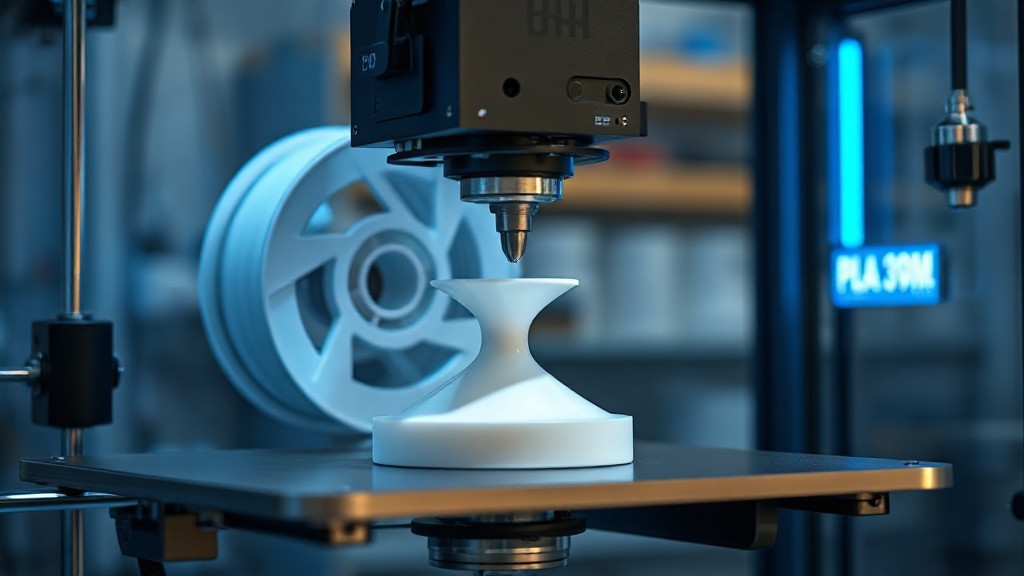

Food-Safe PLA Filament: What Does the Bambu Lab PLA Pure Announcement Tell Us?
Food-safe PLA filament is back on the agenda thanks to PLA Pure, which Bambu Lab announced on 18 June. The gist of the news is this: by highlighting cleaner content, lower emissions and a traceable raw-material approach in FDM printing, the company wants to raise safety expectations on the PLA side.
What stands out in the PLA Pure announcement?
According to the report on DEVELOP3D, PLA Pure comes with a five-component formula, and each of these components is positioned as compliant for food contact under the EU 10/2011 framework. On top of that, the product emphasizes low particle and VOC emissions. This detail matters especially for those producing prototypes, educational aids, small enclosures or visual models that come into contact with users on desktop FDM printers; because the conversation is no longer just about whether a print can be made, but about the material being processed in a more predictable and cleaner way.
The critical distinction here is this: a filament’s claim on its own does not mean the finished part is directly food-safe in every scenario. Nozzle cleanliness, gaps between layers, how the part is used after printing and environmental hygiene are still decisive factors. Even so, a launch of this kind shows that material transparency on the FDM side will increasingly be questioned.
Why does this news matter for Ucuz3D customers?
Because Ucuz3D focuses on FDM production, a development like this supports the shift from a “just get it printed” approach to a “choose the filament that suits the application” approach in material selection. If your project involves a toy-like part, an educational model, a lightweight prototype or an enclosure that comes into contact with users, you first need to clarify the material family that fits the application. That is why sharing your use case before ordering, through the request a quote now page, helps determine not only the price but also the right production direction.
If you want to compare general material differences, Ucuz3D’s print materials page, where we describe our 17 material options, is a good starting point. Because while PLA is enough for some projects, when higher heat resistance, impact strength or outdoor resistance is required, moving to PETG, ABS, ASA or engineering-grade alternatives may be the better choice.
What should you look at for safety and quality in FDM printing?
When evaluating news of this kind, you need to look at the application side rather than just the marketing line. The following points are especially important:
- Raw-material transparency: How clearly is the filament’s content and supply chain disclosed?
- Emission behavior: How are particle and VOC levels managed during long prints in enclosed spaces?
- Print stability: How do nozzle build-up, flow consistency and layer quality perform in the field?
- Part use scenario: Is the part decorative, will it be held, will it go into education, or will it carry a functional load?
Within this framework, to get a clearer picture of PLA’s general behavior, the PLA filament features and use cases guide is also a good reference. That way, instead of drawing big conclusions from a single piece of news, you can evaluate PLA’s strengths and limitations in a real usage context.
Conclusion: the practical takeaway from the news
Bambu Lab’s PLA Pure launch shows that expectations for cleaner content, lower emissions and more traceable filament are growing in the FDM ecosystem. For Ucuz3D, the practical meaning of this is to first define the intended use in every project and then choose the right filament class. If you too want to clarify which material makes more sense for your part, sharing your project with a short technical summary lets you quickly determine the right production path.


 Türkçe
 العربية
 Русский
 فارسی
فارسی Deutsch