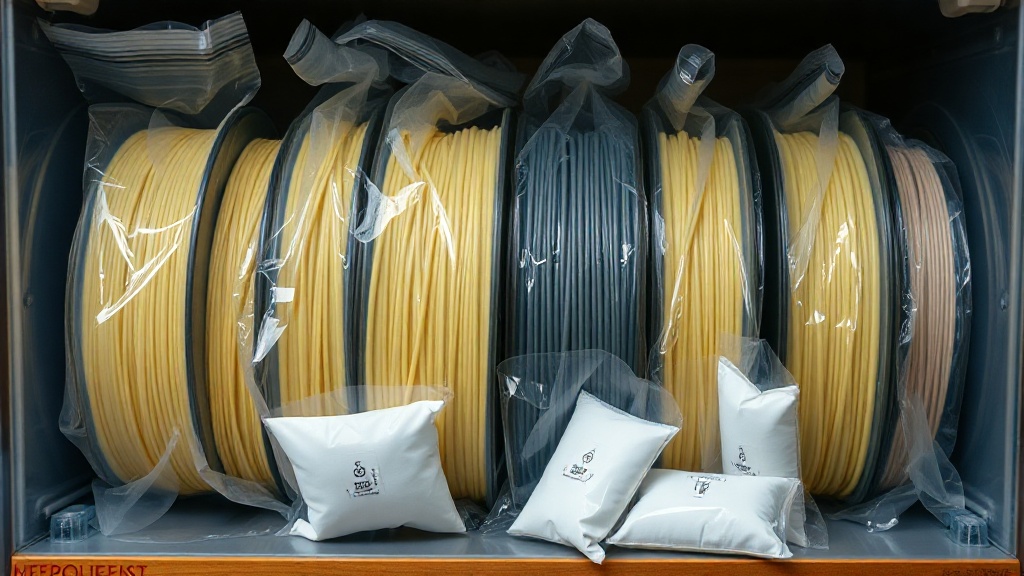

Filament Storage Guide: Vacuum Bags, Silica Gel, and Your Own Dry Box
If a spool you opened a few weeks ago has started making crackling noises, showing surface fuzz, or sagging on bridges, the problem is usually not the filament itself but the moisture it has absorbed. Building good filament storage habits is the cheapest investment you can make to improve both print quality and spool lifespan. In this article we share practical methods ranging from vacuum bags and silica gel to a simple dry box you can build at home.
What does moisture do to filament?
Materials like PLA, PETG, ABS, and especially nylon absorb moisture from the air. When a moisture-saturated filament melts, the water inside vaporizes — causing bubbles, popping sounds, and weak layer adhesion in the extruded strand. Nylon and TPU are the most sensitive in this regard, while PLA is affected faster than it appears.
Vacuum bags: the most practical starting point
Vacuum storage bags used in the kitchen work very well for filament too. By placing a spool in a bag and removing the air, you minimize the surface area exposed to moisture. A few tips:
- Always include a packet of silica gel in each bag.
- Protect any sharp spool edges that could puncture the bag.
- Where possible, choose a gel with a humidity indicator (color-changing type).
Using silica gel efficiently
Silica gel is inexpensive, but it becomes useless once saturated. The good news is that most types are reusable. Color-changing varieties turn pink/green when saturated; you can dry them in an oven at a low temperature or according to the jar’s instructions and use them again. Keeping a small jar next to an active spool and larger packets inside the storage bags strikes a good balance.
Building a dry box at home
If you print continuously, repeatedly opening and closing a vacuum bag becomes tedious. An airtight plastic storage box with a sealed gasket is a life-saver at this point. By drilling a small hole in the side of the lid and threading a PTFE tube through it, you can feed filament directly without ever removing the spool from the box.
- Choose a box with a solid rubber gasket and a locking lid.
- Place plenty of silica gel and an inexpensive humidity meter (hygrometer) inside.
- Mount the spool on a bearing or rod so it can rotate freely.
- Try to keep the target humidity in the 15–20% range.
For highly sensitive materials like nylon, passive storage may not be enough; in that case a heated filament dryer delivers more consistent results. That said, a good dry box handles the vast majority of materials comfortably for everyday use.
Working with properly stored filament takes care of half the job; if you would like to leave the rest to us, you can submit your print request through our quick order page or reach out to us for advice on material selection.




 Türkçe
 العربية
 Русский
 فارسی
فارسی Deutsch