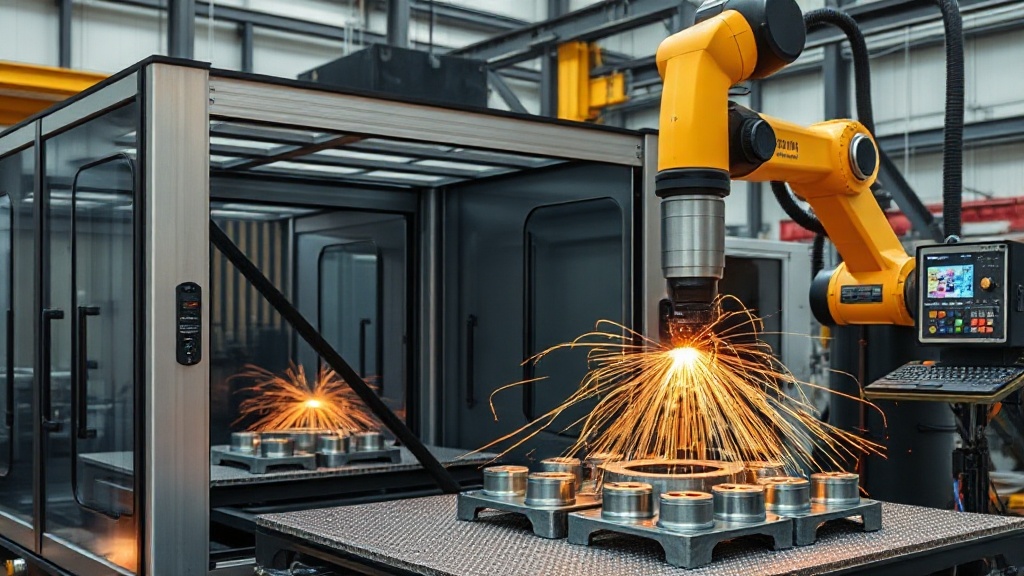

Caracol and Eligio Re Fraschini Confirm 50% Weight Reduction in Aerospace Tooling with WAAM
WAAM aerospace tooling is back in the spotlight thanks to news from 3D Printing Industry dated June 8, 2026. The substantial weight reduction achieved in WAAM-based aerospace tooling shows how 3D printing can make a real difference in large-scale metal manufacturing. Developments like these demonstrate that 3D printing is rapidly maturing — not only as a prototyping tool, but across diverse fields such as financing, process control, materials, biocompatibility, maintenance, and high-performance engineering.
Why is this critical for aerospace and defense?
Tooling applications are among the areas where additive manufacturing delivers the most practical returns. Here, weight reduction directly contributes to operational performance.
What truly sets the industry apart today is not simply that the technology “works,” but that it is becoming clear in which use contexts it delivers sustainable, measurable, and repeatable results. That is why recent news coverage increasingly focuses not just on printer specifications, but on supply chains, quality discipline, application engineering, and business models.
- Additive manufacturing is a powerful tool for low-volume but high-impact parts.
- Geometric freedom, weight reduction, and rapid revision cycles make a huge difference in aerospace.
- Without quality documentation and repeatability, scaling in this field becomes very difficult.
What does this mean for Turkey’s aerospace and defense ecosystem?
For companies that do not engage in high-volume production but have complex fixture and auxiliary tooling needs, 3D printing can offer a faster and more efficient path than traditional manufacturing.
From our experience at Ucuz3D across many projects, the reality is this: successful outcomes do not come from fast printing alone. When the right material, the right geometry, the right use scenario, and a realistic delivery plan are all considered together, 3D printing becomes far more powerful. That is why, when you explore our aerospace-focused auxiliary parts approach, it becomes much clearer why application-driven decision-making is critical.
The practical lesson from this news
The common thread running through this type of news over the past month is that the additive manufacturing ecosystem is no longer just carrying a “new technology” narrative. The market is asking increasingly concrete questions: Who does this solution create value for, what cost does it reduce, which cycle does it accelerate, and which quality risk does it mitigate? For exactly this reason, it is important to read current 3D printing news not merely as news, but as early signals for new business models, supply strategies, and product development methods.
If you would like to clarify the right 3D printing approach for your project, or technically evaluate your need for a functional prototype or low-to-medium-volume production, you can share the details on our quick order page or create an initial framework by reviewing our production pricing.




 Türkçe
 العربية
 Русский
 فارسی
فارسی Deutsch